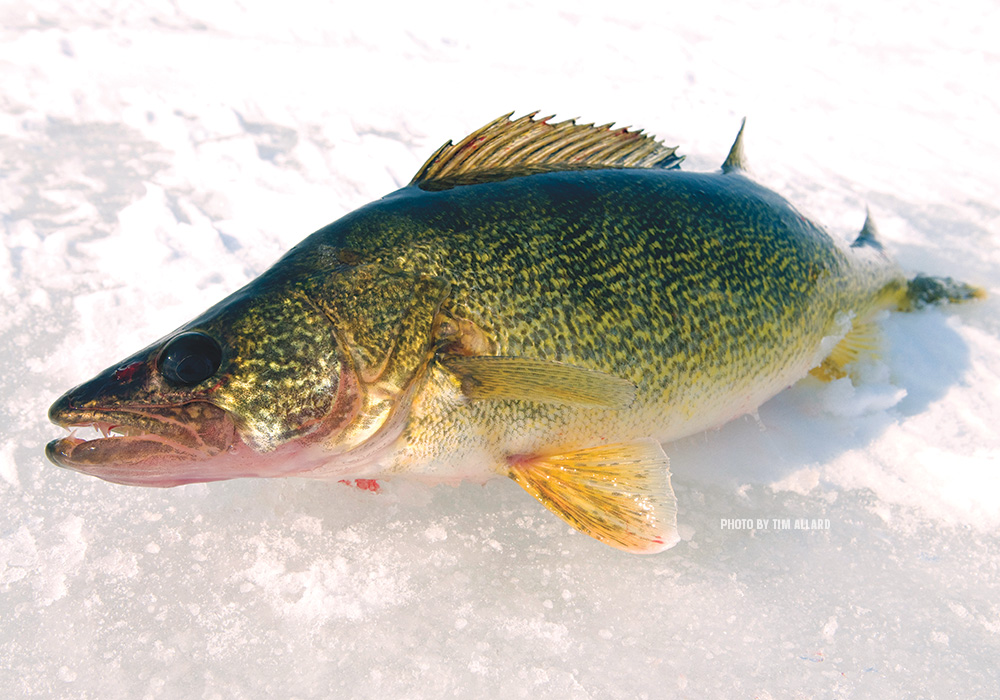
Walleyes love edges. No matter the mood of the fish, type of waterbody or phase of winter, locating and jigging around edges is one of the best ice-fishing strategies for walleyes. Getting your lure around drop-offs, bottom composition transitions and weedlines is as effective for catching inactive fish with a small strike zone as it is for getting the attention and triggering strikes from actively feeding ‘eyes oriented along those edges.
An Array of Edges
Walleyes relate to a variety of different kinds of edges throughout the winter. Certain edges, like drop-offs, are fairly easy to find. Although, as one might expect, less distinct features, such as hard-soft bottom transitions, take more legwork to locate.
Drop-offs
Walleyes often collect around structural edges that result in a depth change. The most pronounced of these features is a drop-off, which contains two major edges. One is the top pivot point, marking the beginning of the slope’s descent. The other is at the base, where the slanting drop-off meets a flatter bottom.
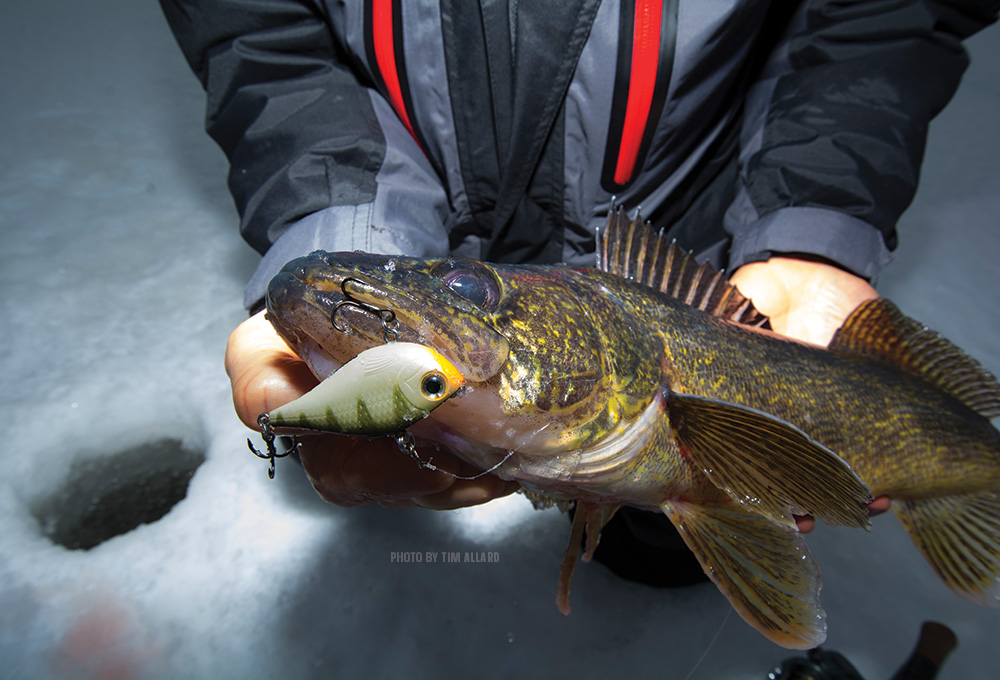
A common pattern is for inactive walleyes to relate to the deeper edge during the day, and moving higher once they get active. During twilight, an angler may catch fish from the upper portion of a drop-off, for example. Important to keep in mind, though, is staying with the fish. This may require repositioning to follow walleyes hunting baitfish on shallow flats or the crown of an offshore hump, point or structure.
Walleyes also often hold along the slope of certain drop-offs. In my experience, this often happens on irregular downslopes containing a series of smaller stair-like drops. All things being equal, expect to find walleyes relating to the structural steps located within their preferred depth range. In other words, when fishing a lake where a lot of ‘eyes get caught in 24 to 30 feet, expect sloping stair-steps found at these depths to be especially productive.
One challenge that anglers can encounter is how to pinpoint walleye position along a prolonged drop-off ledge running perpendicular with the shore. One shortcut is to look for variations along the contour, such as inside and outside turns. Large points and sandbars, extending away from a drop-off, often serve as pathways for walleyes’ deep-shallow movements, and are other good finds.
Boulder Strips and Rock Slides
Hard-bottom ridges rising off the bottom are another awesome edge feature when it comes to catching walleyes. Two top finds are boulder strips and rock slides.
These elongated, hard-bottom ridges have a propensity to draw in good numbers of walleyes, whereas random, isolated boulders and rock piles may only collect a few fish. Boulder strips and rock slides also often serve as travel corridors, funnelling concentrations of ‘eyes through specific areas.
Years ago, I had an exceptional day on the Bay of Quinte in the hours preceding a snowstorm. Walleyes were amped up and chasing schools of yellow perch across a massive soft-bottom flat in about 28 feet of water. After plenty of hole-drilling reconnaissance, my friends and I eventually found a rock strip rising a couple feet out of the muck. This put us over a walleye highway where pods of fish would swim by in waves every 20 to 40 minutes. It was fantastic fishing.
I’ve since caught fish from rock strips rising up off flats on numerous inland lakes. Elongated boulder and rock formations strewn across offshore humps also frequently produce fish.
Hard-Soft Bottom Transitions
The rocky ridges traversing sand flats are an example of a hard-to-soft bottom transition. Along with this, these locations also contain a depth change of at least a foot.
This is all well and good, but there are many soft-to-hard bottom areas featuring minimal depth changes that appeal to walleyes. A pea gravel deposit in clay, for instance, can be all that’s needed for walleyes to mill around a specific spot within an area. They also commonly congregate along rock-to-sand transitions. Like the other edges described previously, expansive hard-soft bottom transitions often act as pathways for walleye movements.
Weedlines
No discussion on fishing walleyes around edges is complete without the mention of weedlines. At first ice, getting around healthy cabbage and coontail is one of the best things you can do to find biting walleyes on many lakes.
Vibrant vegetation can hold a buffet of perch, baitfish and various invertebrates. Walleyes typically actively feed on overcast days, and at twilight and night. Getting along a weedline is smart as they regularly patrol these edges looking for prey to flush out into the adjacent open water to attack.
Another pattern that anglers need to keep in mind is how edges formed between chara (aka sand grass) and soft-bottom areas can channel perch and, in turn, walleye movements on these dishpan areas. An underwater camera helps with finding these zones, but equally important is being aware of the phenomenon. If you’re fishing one of these areas and find yourself not catching fish like your buddies, take it as a signal that you might not be positioned over one of these kinds of edges. Move and jig other holes until you contact some ‘eyes.
Tools and Tactics for Finding Good Edges
Ice anglers can use a variety of techniques to reduce the number of holes they need to drill to get on fish-producing edges. One reliable option is using fall fishing outings to find productive edges for the upcoming ice season.
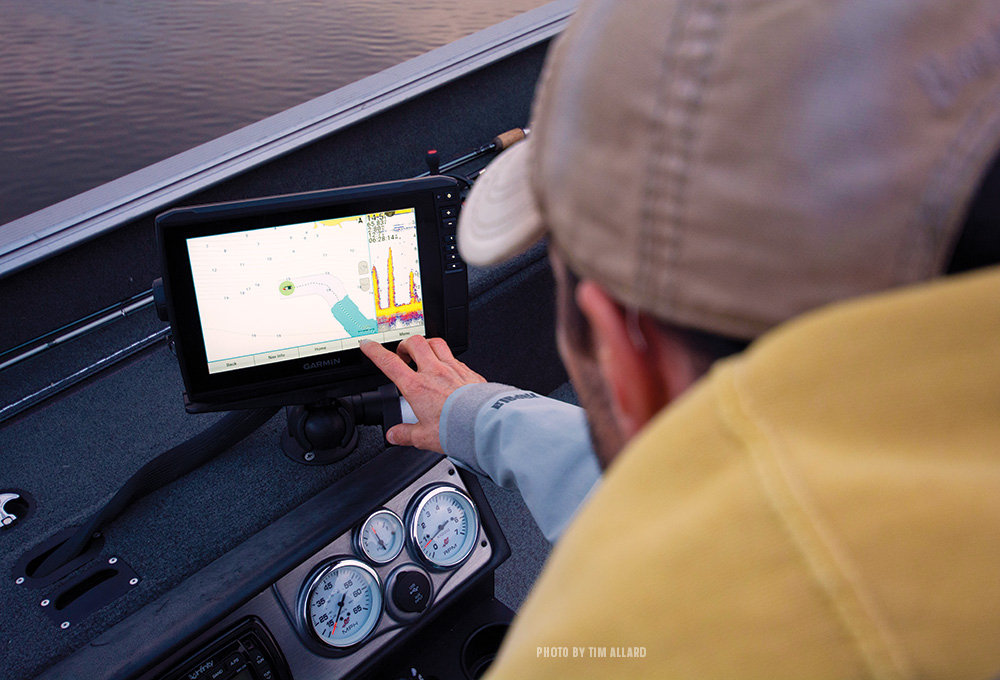
Technology helps. The best scenario is being able to sync GPS waypoints from your boat sonar to your hard-water unit. Likewise, using a chartplotter to make your own depth contour map can reveal subtle rock spines, and other less obvious edges not always shown on standard mapping cards or downloads.
Still, whether using purchased or do-it-yourself data, a digital contour map able to show your GPS location is an asset once you put boots to ice. Many digital flashers today come as sonar/GPS units with included maps.
For those preferring a mechanical flasher, there’s likely a solution in your pocket — a smartphone. Several apps are available providing digital fishing maps you can use to get over the top of edges associated with points, offshore humps, saddles and other structures walleyes frequent in winter.
Knowing how a portable ice sonar displays hard versus soft bottoms, and keeping a close eye out for these changes when hole-hopping, helps identify bottom transitions. Paying attention to the vibrations coming up the line when a jigging lure hits bottom is another simple, effective way to keep tabs on bottom composition changes between holes.
Forward-facing sonar provides many advantages for catching walleyes relating to edges. And given the buzz around this cutting-edge technology, I appreciate this is stating the obvious to a certain degree. Regardless, it deserves mention.
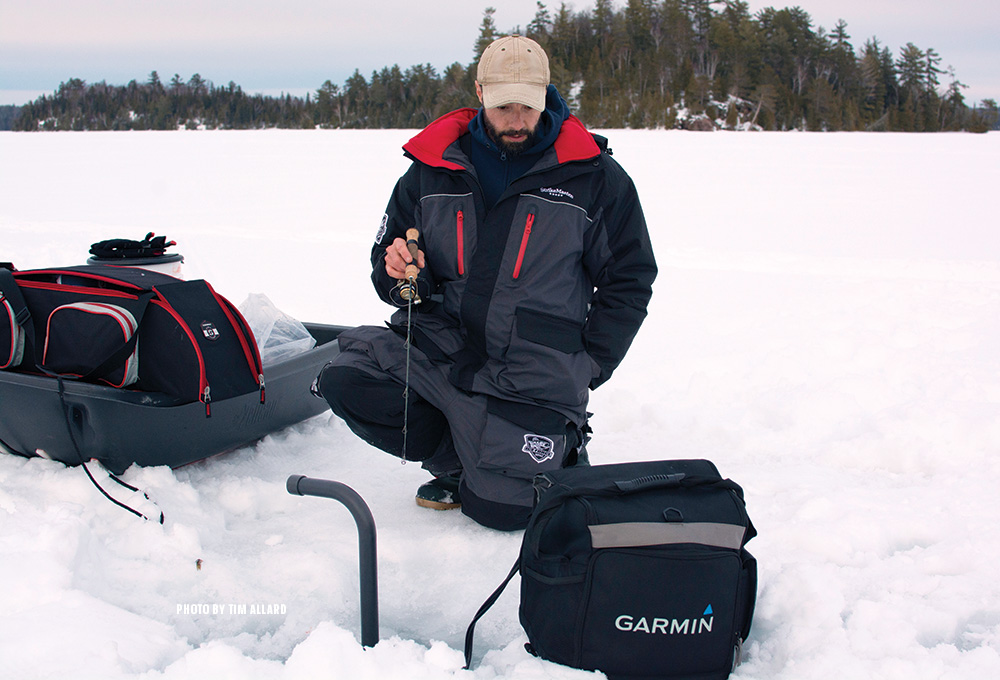
Surveying water using the Garmin LiveScope Forward live-scanning view has dramatically improved my efficiency for finding productive weedlines and all kinds of structural edges holding walleyes. Quickly scanning 100-plus feet of water in all directions from one hole by simply panning the transducer around via its mounting pole is extremely efficient and effective. Once an edge is located, the detailed forward view assists with drilling holes with enhanced precision over prime spots, while LiveScope Down view provides an outstanding real-time visual when jigging.
Edgy Fishing Techniques
You don’t need any special edge-centric lures to fish the locations discussed in this article. Really, a box with a dozen or so baits from a few different lure categories will do just fine. But, there are a couple important things to keep in mind when choosing what to tie on.
Jigging in Tight Quarters
If holes are drilled close to a weedline, it’s probably not a good idea to use a flutter spoon or other lure with a sideways, gliding action that risks snagging the nearby greenery. Instead, use a straight spoon, lipless crankbait or jig tipped with a live or artificial minnow, since all of these baits have fairly vertical falling actions. A similar rationale also applies when jigging uneven, rocky stair-step ledges.
Laws of Attraction
Keep in mind, too, that a walleye’s vision is limited along irregular weedlines and jagged slopes. Using rattling lures or vibration-heavy spoons, such as a Berkley Vibrato, to stimulate nearby walleye’s acoustic senses is one way to get your lure noticed by more fish. Regularly jigging the lure high off of the bottom, say between two to eight feet also helps.
There’s a lot more wiggle room on bait selection when fishing edges where snags are limited or nonexistent. Really, it’s angler’s choice in terms of what to tie on when fishing rock spines, hard-soft bottom transitions and slow-tapering drop-offs, such as those associated with a sandbar.
One option is starting with a lure exhibiting a lot of drawing power and triggering action. Falling into this category are gliding lures with strong visual appeal, like the Rapala Shad Rap and flutter spoons, as well as lipless crankbaits, rattling spoons and slab-style spoons.
Regardless of the lure, standard ice-fishing methods apply when fishing edges. This includes experimenting with different jigging intensities, observing fish response using a portable sonar and then making adjustments accordingly.
Triggering Strikes
When aggressive jigging tactics with action- and vibration-rich lures don’t trigger strikes, it’s time to slow down and start experimenting with different lure types, sizes, profiles and colors.
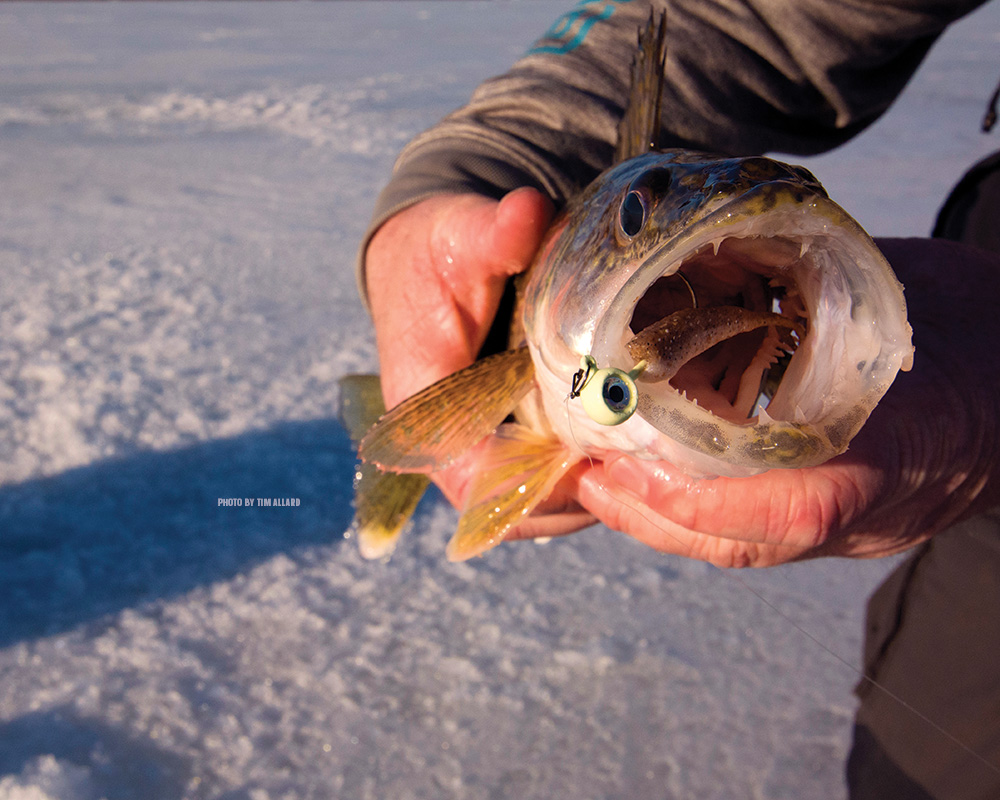
Downsizing is a reliable approach. It’s amazing how dropping to a smaller lure, combined with a more subtle jigging cadence, can flick a switch in a walleye’s brain and get it chewing. Likewise, when changing from a high-action bait to one with conservative movements.
Using live bait is another tried-and-true way to put more fickle walleyes on the ice. A minnow on a jig is old-school, but potent nevertheless. Jigging a hole in close proximity to a minnow soaking on a dead-stick is also rarely a bad decision.
If real minnows aren’t in the cards, consider a scent-loaded plastic minnow as an alternative. Recently, I’ve had good success with soft baits for clear-water walleyes.
As you’d expect, an artificial on a dead-stick setup needs jigging now and then to keep up the ruse. Believe it or not, though, I’ve had days when cranky walleyes relating to a hard-soft bottom transition were more interested in eating an almost stationary soft bait, so I gave up jigging and used two dead-sticks for my legally permitted fishing lines. If you give this a try, position the jigs at different depths, such as placing one bait 18 inches off of the bottom and the other suspending three feet or so above the floor.
Walleyes can’t get enough of edges, and as anglers it’s important not lose sight of this fact. There will always be new, more advanced ice rods, lures and sonar coming to market — and while fishing equipment upgrades can help improve on-ice success — there’s a lot to be said about sticking to the basics. And few things are as fundamental for catching walleyes as focusing efforts on fishing edges.
Read more related articles below: