
Where are all those deer?
Following my earn-a-buck post, I expected a lot more comments like the one posted by Ron, basically blasting EAB. Perhaps the majority of hunters just glazed over the whole thing? Or, maybe things aren’t as bad as I believe? Maybe a lot of hunters do understand that deer populations are still too high in many areas. Frankly, I doubt that.
I doubt it because one of the biggest problems with modern deer management is that when deer populations explode, many hunters never see it — especially in the states with the most hunters. At it’s heart is the disparate localized distribution of deer (or clumpiness, as retired Wisconsin DNR deer researcher Keith McCaffery calls it) and land ownership trends.
The short version is this: Deer are wild animals that go where they want to go. Today’s hunters are limited by property constraints that are increasingly narrowed. Thus, some hunting groups frolic in over-abundant herds, while other hunters, (guys like Ron) sit in woods with few or no deer.
Although game departments are charged with managing deer populations for the public as a whole, they have little control over individual private properties. State managers break up their tasked areas as best as they can, often into deer management units that cover county-sized areas in the range of 500,000 acres. This is partially because it takes a large sample size to produce a reliable count, and partially because of limited resources. So, for a statewide manager, that’s a tiny area to localize regulations to. But a hunter limited to just 40 of those 500,000 acres might find that "his herd" doesn’t match up with the over-goal lands around him.
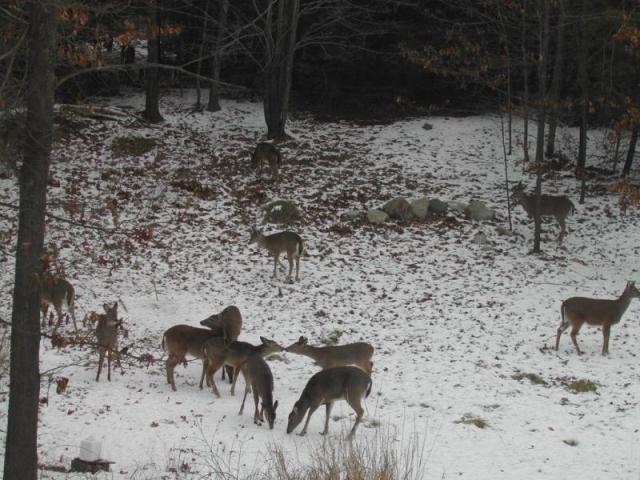 Deer & Deer Hunting editor-in-chief Dan Schmidt often uses this example in his lectures: Think about the square mile around your hunting area. That is 640 acres. If the deer population goal for the area is 25 deer per square mile, each 40 acre property would be allotted roughly 1.5 deer if they were distributed equally. However, if you were to see 10 deer on one 40-acre soybean field, that only leaves 15 for the remaining 600 acres.
Deer do not distribute evenly. Land management, agriculture, as well as hunting practices, all influence deer distribution.
"I have rarely argued with a hunter that claims there are few or no deer where he hunts because his claim could be true," McCaffery said. "This can especially be the case if he or she is attempting to hunt a 10- or 40-acre ownership."
Even when expanded to square-mile blocks, deer populations are clumpy. For example a recent aerial survey in the CWD zone of Wisconsin found counts ranged from zero to 147 deer on individual square-mile survey blocks. Of course, not all deer were probably seen and counted. But it shows the problem inherent for managers.
Managers such as McCaffery cite cover and food as the main causes for deer clumpiness. Hunting pressure also makes a difference. Huge clumps of deer exist within urban zones where hunting is restricted. Baiting, food plots and selective harvest patterns can also increase clumpiness.
What’s the answer to this problem? How do we manage a disparate population, keeping hunters happy with full freezers and our forests healthy? This is probably a game manager’s most difficult task.
For our part, ethical hunters must be both understanding and steward-minded. If we happen to fall outside of a "clump" we must recognize that some areas might be temporarily "over-shot," as McCaffery puts it, on occasion to protect those lands and a multitude of other interests. He reminds us that "forests are far more threatened by over-abundance of deer than scarcity."
Hunters within those clumps of heavy deer distribution can do more. These are the hunters who must kill more deer than their current harvest threshold allows. This is land stewardship. Plus, in a round-about way, reducing populations within high-density areas will help spread the wealth of venison to hunters outside the main clumps by allowing managers to reduce harvest goals over the broader management area.
Related Articles


DNR Updates Hunters On Sweeping Changes
In July, Wisconsin Governor Scott Walker’s office released an independent report by “Deer Czar” Dr. James Kroll. The report brought about plenty of criticism from within the state (See D&DH Editor Dan Schmidt’s thoughts HERE), but regardless it called for some major changes in deer management in the state. The following is the DNR’s update […]
Read More about DNR Updates Hunters On Sweeping Changes
Shooting Hours App: Great Idea, But Shouldn’t It Be Free?
The Wisconsin Department of Natural Resources recently announced a new app for Android phones (iPhone coming soon?) that will allow hunters to check the exact time for shooting hours in their hunting location. No more confusing maps or forgotten regulations booklets and wondering if that buck or duck coming into your spot is fair game. […]
Read More about Shooting Hours App: Great Idea, But Shouldn’t It Be Free?