
Crossbow Broadhead Performance: What High-Speed Bows Demand
Modern crossbows can deliver impressive speed and accuracy, but the broadhead still has to finish the job. Check these five things before trusting your setup on a whitetail.
A crossbow broadhead has a tough assignment. It must remain stable during a high-speed launch, fly accurately with the hunting arrow, survive impact and still deliver the penetration and cutting performance needed to reach a whitetail’s vitals.
That sounds simple until you consider how much crossbow technology has changed. Modern hunting crossbows are faster, more compact and more precise than their predecessors. Deer & Deer Hunting has documented that evolution as crossbows have become increasingly common in the whitetail woods, but additional speed does not remove the fundamentals of bowhunting. It makes attention to the entire arrow system even more important. Read more about the evolution of modern crossbow hunting here.
Before opening day, these five areas deserve a close look.
1. Start With Crossbow Broadhead Accuracy
Cutting diameter does not matter if the arrow misses its mark.
The first job of any hunting broadhead is to hit where the shooter expects it to hit. Broadheads introduce blades, additional surface area and weight to the front of the arrow, and even small inconsistencies can show up once hunting heads replace field points.
Never assume a hunting arrow will strike in exactly the same place simply because the field-point setup groups well. Shoot the actual broadheads before season. Verify them at the distances you expect to encounter in the woods and from the positions you actually hunt.
This is one area where practice-friendly broadhead design is useful. SEVR incorporates its Practice Lock system into its crossbow-specific X Series, allowing hunters to lock the blades in place and shoot the same head they intend to hunt with without deploying and dulling the blades.
That means point of impact can be confirmed with the actual broadhead rather than relying entirely on a separate practice head.

2. Pay Attention to Broadhead-to-Arrow Fit
The broadhead is only one part of the projectile. The ferrule, insert and arrow shaft all have to work together.
Crossbow arrows often have larger outside diameters than arrows used with vertical bows, and the transition between the broadhead and arrow deserves attention. A broadhead base that is noticeably narrower than the shaft can create an abrupt shoulder at the front of the arrow. A clean, properly matched transition creates a more unified projectile.
This was one of the design considerations behind SEVR’s current crossbow-specific X Series. According to SEVR, the company developed a stronger, wider base to increase impact strength while creating a smoother transition to common carbon and aluminum crossbow-arrow diameters.
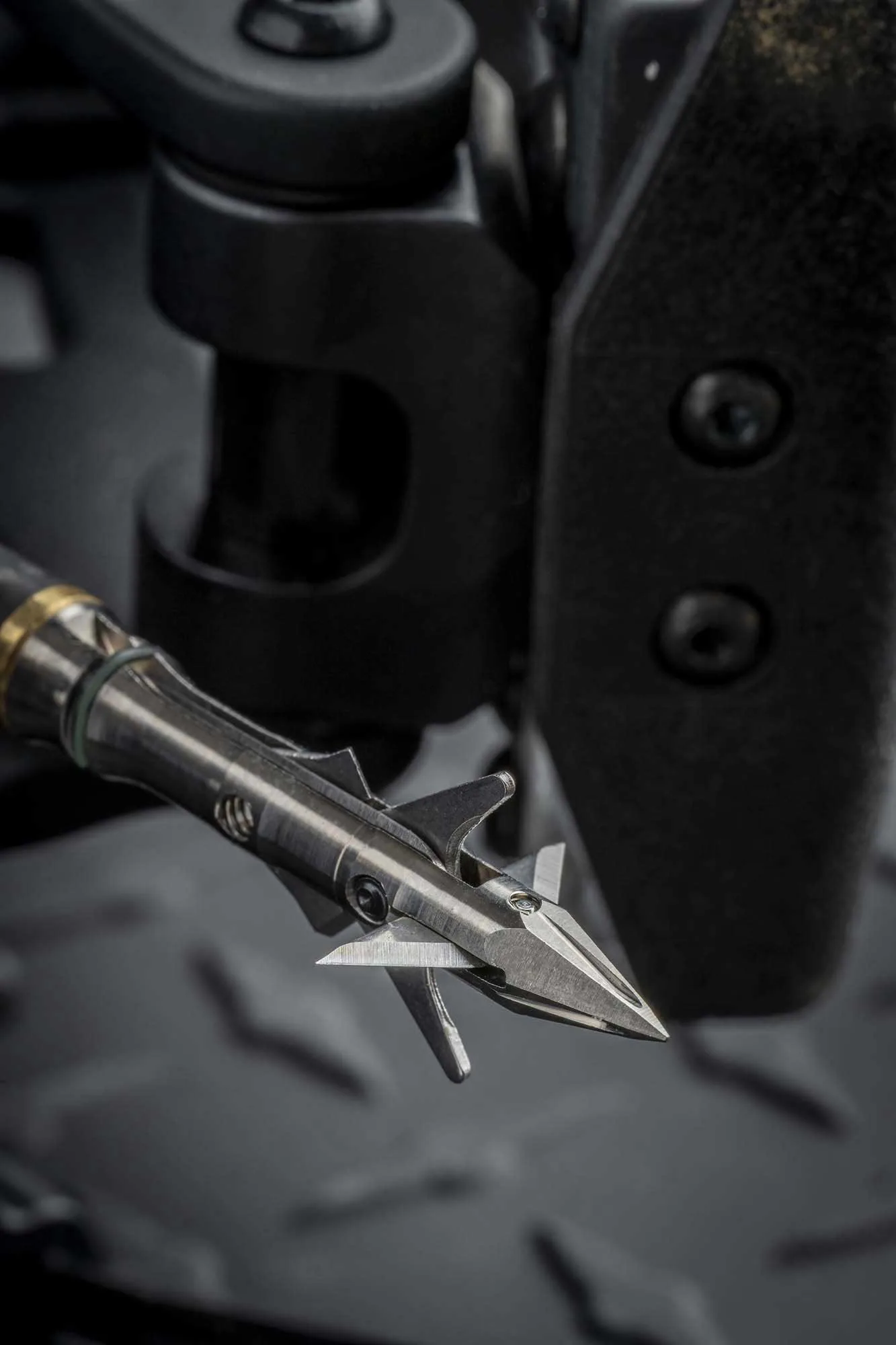
The SEVR Ti 1.75 X Hybrid Crossbow Broadhead uses a one-piece machined titanium ferrule and precision-ground tip, with the wider crossbow-specific base built into the ferrule design.
It is a detail hunters might overlook when shopping by cutting diameter alone, but the way the broadhead meets the arrow matters when the entire projectile has to remain aligned through launch and impact.

3. Balance Cutting Diameter With Penetration
Big cutting numbers attract attention. They are easy to understand and easy to compare on a package.
But broadhead performance is a balance.
A larger cutting surface can create more tissue damage and potentially improve blood trails, but opening blades and pushing them through hide, muscle and other tissue requires energy. Arrow weight, speed, shot angle, blade angle and broadhead construction all factor into the equation.
The best choice is not necessarily the broadhead with the largest number printed on the package. It is the one that gives your particular setup enough cutting performance while still providing the penetration required to reach the vitals.
This is also why shot placement remains more important than broadhead design alone. Even the best mechanical broadhead cannot compensate for a poor hit.
SEVR offers two different approaches within the X Series. The Ti 1.75 X Hybrid combines a 1.75-inch rear-deploying main blade with a 0.75-inch fixed bleeder blade, creating 2.5 inches of total cutting surface. It is available in both 100- and 125-grain configurations.
The SEVR Ti 2.0 X Crossbow Broadhead takes a two-blade approach with a 2-inch locking-and-pivoting main blade and is likewise offered in 100- and 125-grain versions.
Those are two different ways of solving the same problem. One adds fixed bleeder blades to the mechanical main blade. The other concentrates its cutting performance in a larger two-blade design.
The right choice depends on the complete hunting setup rather than one specification.

4. Consider What Happens After Impact
Broadhead testing often centers on flight, but the real work begins at impact.
A perfectly broadside deer provides the simplest path to the vitals. Real hunting situations are not always that tidy. Deer move. Body angles change. An arrow may encounter a rib or other resistance on its path through the chest.
That makes ferrule strength, blade construction and the way blades respond to resistance important considerations.
SEVR’s X Series uses the company’s Lock-and-Pivot blade system. According to SEVR, the blades lock open after deployment but can pivot when they encounter resistance, helping the arrow maintain a straighter path rather than forcing a rigid blade against an obstacle.
That feature should never be interpreted as permission to take poor shots. Broadhead technology does not replace sound shot selection.
Hunters still need to understand whitetail anatomy, know how the vitals shift on quartering animals and recognize when an angle does not provide an ethical path through the chest cavity.
A broadhead is insurance for what can happen after a good shot is released. It is not a substitute for making a good decision before pulling the trigger.
5. Test the Entire Hunting System
Broadhead testing should not happen in isolation.
Arrow weight, insert weight, broadhead weight, nock compatibility, shaft straightness and overall balance all influence arrow flight. Change one part of the system and it is worth confirming the setup again.
If you switch from a 100-grain head to a 125-grain head, for example, you have changed total projectile weight and front-end mass. Point of impact can change. If you move to a different arrow, insert or nock, check everything again.
Then leave the bench.
Crossbows are extremely accurate from a stable rest, but deer are not always encountered from a shooting bench. Practice from a treestand. Practice from a blind. Shoot while wearing the jacket and gloves you expect to use in November. Verify elevated shot angles and make sure the crossbow clears blind windows, shooting rails and branches.
Speed can make a crossbow easier to shoot accurately, but it does not eliminate human error or deer movement.
The best maximum hunting distance is not whatever number appears in a crossbow advertisement. It is the farthest distance at which the hunter can repeatedly put the complete hunting setup into the vital zone under realistic conditions.
Don’t Let Speed Hide the Fundamentals
The newest crossbows are capable of impressive performance. Current hunting models reaching the 400-fps range are no longer unusual, and manufacturers continue to push crossbow technology forward. Recent Wicked Ridge models, for example, are rated at 400 fps.
But deer hunting still comes down to a surprisingly short list of fundamentals.
Know where the arrow hits. Use compatible components. Pick a broadhead that matches the arrow and hunting setup. Understand shot angles. And practice until there is no question about what the equipment will do when the opportunity arrives.
A modern crossbow broadhead can be engineered specifically for the speed and dimensions of today’s equipment, but technology only works when the hunter does the preparation first.
That is ultimately where confidence comes from — not the speed printed on the box, but knowing the entire system has already proven itself before a deer steps into range.
Sponsored Content: This article was produced in partnership with SEVR Broadheads.
Read More From Deer & Deer Hunting
Making the Switch: More and More Deer Hunters Are Embracing the Crossbow
Crossbows have changed dramatically in speed, accuracy and popularity. Here’s a deeper look at their growing role in modern deer seasons.
Best Mechanical Broadheads for Deer Hunting
Broadhead performance still starts with shot placement. See what matters when choosing and hunting with mechanical heads.
Top 15 Broadheads for Deer Hunting
Compare different approaches to broadhead construction, cutting diameter, penetration and high-speed performance.
Wicked Ridge Launches Two New Crossbows for 2026
A look at current 400-fps crossbow technology and the performance modern hunting equipment is delivering.

Related Articles

Bear Archery Alaskan Pro RTH+: A Premium Ready-to-Hunt Package
Bear’s Alaskan Pro RTH+ pairs the proven hunting bow with more than $340 worth of Trophy Ridge accessories.
Read More about Bear Archery Alaskan Pro RTH+: A Premium Ready-to-Hunt Package
Real World Nutri-Crave Deer Corn: A Higher-Protein Supplemental Feed
Real World Nutri-Crave Deer Corn combines two corn varieties in a supplemental feed designed to offer increased protein while retaining high fat levels.
Read More about Real World Nutri-Crave Deer Corn: A Higher-Protein Supplemental Feed
Easton X10 Parallel Pro Hunter: Precision Built for Bowhunters
The Easton X10 Parallel Pro Hunter brings premium X10 precision to bowhunting with a 4MM profile, A/C construction and ±.001-inch straightness.
Read More about Easton X10 Parallel Pro Hunter: Precision Built for Bowhunters