Of Big Bucks & Public Hunting Land

Big buck in velvet
photo courtesy of Scott Bestul

In today’s mailbag, Jesse Lane writes:

"I have a public hunting land question. I was out last night watching the fields and had a HUGE whitetail buck come out. There usually isn’t too much pressure there for archery season which starts Oct 1st but my question is how far could this deer travel till the season starts or into the season. I would love to get a shot at his when the season starts."

Deer & Deer Hunting Editor Dan Schmidt responds:

Well, it sounds like you have a great buck to hunt this fall, Jesse. He could be around, but he also could move quite a distance. The biggest deer are still in their summer core pattern right now, which means they will be in a corner of their square mile range. But public land is different … that range could be much larger. Rule of thumb, however, is that they won’t move too far out of that 640-acre home range until mid to late October. then they could be traveling up to 5,000 acres.

Another important point to remember is that a buck’s core area is usually one-third of the size (and sometimes smaller) than his home range. That core area is going to be the best of the best of that habitat. Therefore, it’s wise to gain an in-depth understanding of the natural food, water and cover realities of the property. This will help you pinpoint the best places to hunt him as the season progresses.


Best Trail Camera Photos Come From Up High

Big buck in velvet

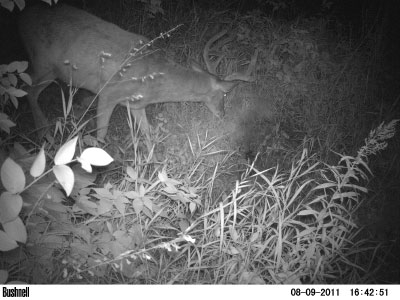
Want to get the most out of your efforts? Try mounting your scouting camera two or three times higher than you normally would; you will not only get better images, you will alert fewer deer to your presence.

I learned this trick from Deer & Deer Hunting field editor Les Davenport. He told me to strap my cameras 5, 6, even 7 feet off the ground and point them down toward the trail or spot where I expect deer to show up. The tactic has worked. In the past, I’d get one or two photos of a particular buck before he would wise up to the camera’s location and avoid it altogether. As you can see from this photo, the buck is none the wiser that there’s a camera shooting down on him.

When placing cameras up high, I use a stick or piece of bark and wedge it behind the the camera (at the top) before cinching the strap to the tree. This allows the sensor to point down toward a specific spot. 

For more tips and tactics on how to get the most out of your scouting cameras, check out ouronline course.

The Best Rut Dates Are Often Dictated by Deer Density

Mature whitetail doe with fawn 

Deer & Deer Hunting field editor John Ozoga spent most of his career as a wildlife biologist studying the effects of high deer densities, especially those related to the social stress that’s involved when deer densities exceed a property’s carrying capacity.

According to John, too many deer on the habitat can cause nutritional shortages and psychological stress on the deer herd. These are effects that we hunters and deer enthusiasts cannot see. Hints of these effects, however, can be manifested in symptoms that are revealed subtly in deer behavior — such as a prolonged rut, or a rut that doesn’t seem to "happen."

"Studies have shown that high densities (even in areas with supplemental feeding and the best food plots) can delay peak rut activity among socially low-ranking first- and second-time breeding does by as much as two weeks," Ozoga said. 

This is something to keep in mind as we enter this deer season. If your area is experiencing a boom in the population, it would be wise to take full advantage of your doe hunting opportunities.

To learn more about sound deer management practices, check out this new book by Kent Kammermeyer.

Consider Adrenaline Next Time You Track a Whitetail

Consider physiology when you track a whitetail
Does a whitetail’s internal chemistry make it harder to track and trail a wounded deer? Absolutely. That is why it’s important to understand deer behavior and physiology before heading to the woods this fall.
According to Deer & Deer Hunting Magazine Field Editor Dr. Phillip Bishop, increased adrenaline levels are what help deer put distance between themselves and their predators — especially when a deer is mortally wounded.

"When a deer is frightened, as when shot, its adrenal glands act to try to preserve its life.  The adrenals release massive quantities of adrenaline.  One of adrenaline’s functions is to shift blood flow away from the stomach and intestines and towards the muscle to aid its escape," Bishop reports.  
Bishop also notes that adrenaline causes blood vessels of the skin and inactive muscles to constrict to shift even more blood to active muscles.  Further, to preserve life, adrenaline increases the rate of blood clotting which reduces bleeding.  Together, these actions will certainly make a marginally-hit deer more difficult to track. 
"In contrast, a good hit to the heart and lungs cannot be overcome by adrenaline," he concludes. "Likewise a very sharp broadhead reduces the signals for blood clotting and yield a quicker kill with a better blood trail."
What’s Bishop’s advice to hunters desiring to improve their skills and shorten future blood trails?
1. Keep your broadheads sharp.
2. Wait for a quartering-away or broadside shot, and 
3. Keep your shooting eye sharp. 
For more insights on how to find every deer you shot, check out D&DH’s new "Blood-Trailing Whitetails" CD in our online store. While you’re there, check out our picks for the best broadheads and best arrows for whitetail hunting.

Best Tree Stand Spots Require Sweat Equity

Tree stand tactics
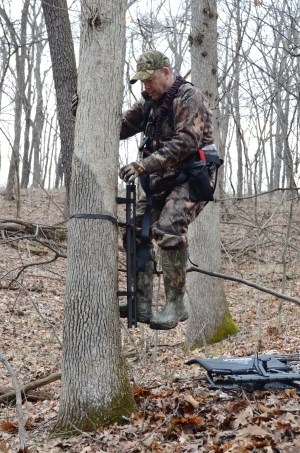
If the tree Dan Schmidt was wrestling with on Saturday were this "skinny," he wouldn’t have anything to report today. (photo by Kris Kandler)

It doesn’t matter how prepared I think I am, hanging tree stands in new spots always seems to be a lesson in humility and physical endurance. And, just like everything else in life, when things don’t go as planned, the problems usually come in threes. Case in point: a tree stand I hung on Saturday.

It all started at the crack of dawn when I found a promising deer trail that wound through some thick berry brush. I thought I’d slip back in there to quickly hang a stand for the early bow season. Saturday’s forecast called for heavy rain in the afternoon, which was perfect. I’d get the stand hung and then it would wash away all of my scent. Great plan, right? Wrong.

Problem #1 was encountered when I realized the only tree suited for a stand was a huge red oak —probably 30 inches across at the base — and it was covered with vines and the remnants of a nearby blow-down. No big deal, thought, as I walked back to the vehicle to gather my gear.

I returned about 20 minutes later with one of my older, but trusted, lock-on style tree stands, five sections of Summit Swiftree ladders, rope and strap ratchets, Seat of the Pants climbing harness, LifeLine rope, pole saw, hand saw and just about everything else I needed. It took me about an hour to prep the site. I cleared brush and vines from the tree’s base, sawed off in-the-way limbs, etc. The ladder went up easily. I thought I’d then hang the stand and get out of there.

Then came Problem #2: As I’m strapped to the tree 25 feet off the ground, I realize the chain on my stand isn’t long enough to go around the tree. The day just got a little longer.

I exit the woods and make the 20-minute walk back to my vehicle, packing the stand out, of course. There’s a sporting goods store on the way home, so I stop to see if I can fix the problem by merely buying a new River’s Edge stand (which were on sale). That would seem like the easiest solution at this point.  While I’m at the store, the sales associate lets me inspect one of the new stands that was on display.

Enter Problem #3: Unfortunately, this new stand won’t cut it, either. That 36-inch strap isn’t nearly long enough to get around that oak tree. Well, now I have to go home and try to devise a new plan.

I started this day in the woods at about 7 a.m. It’s now 1:30 p.m. I’m discouraged but not defeated. It takes some mulling and rummaging around through the garage, but I manage to find a 6-foot length of chain that will suffice as a replacement for the stand. I install it on the stand with some brand new bolts, washers and locking nuts. I’m good to go. It’s time to get back to the woods.

It has taken nearly all day, but the stand is in place — and bomb-proof, I might add — by 3:30 p.m. I won’t know if this spot is going to produce for at least another month, but if and when it does … man, is that going to be the sweetest venison I’ve ever acquired.


Mineral Licks for Deer: Good, Bad or Indifferent?

Whitetail buck at mineral lick

The use of mineral licks on deer hunting properties has skyrocketed in recent years. Although some hunters place licks for the benefit of their herd, many use them solely as a means for acquiring trail camera photos in summer. Do mineral licks benefit the deer herd? Yes, but probably not to the extent that most hunters believe.

Two scientific studies on free-ranging whitetails shed some interesting light on this topic. The first study, conducted in Georgia, indicated that 85 percent of hunters believed the mineral licks they created on their properties helped increase the antler development and body sizes on deer on their land. They further believed that mineral licks were more important to the overall health of their herds than food plots and doe management.

The second study, conducted a year later, indicated that mineral licks did not appreciably increase the body weights or antler development of whitetails. 

"This does not mean that mineral licks are not useful," said D&DH Field Editor Bob Zaiglin, a longtime certified wildlife biologist from Texas. "What it indicates is that mineral licks need to be used in conjunction with sound deer management practices that work in concert with each other."

Mineral supplementation, native habitat management, feeding through the use of food plots, maintaining adequate doe harvest efforts, and attempts to minimize the harvest of young bucks are all pieces of the overall puzzle. Quality deer management takes some pre-planning and hard work, but when done correctly it can reap huge rewards — as in larger bucks for you to hunt.


Summer Deer Pictures Tell 1,000 Words

 Whitetail Deer in Summer

This summer’s extreme heat and humidity have not only taken a toll on our electric bills; they’ve no doubt extracted a toll on white tailed deer throughout the country.

This 2-1/2-year-old doe is a prime example. If you look closely, you’ll see that she is doing her best to ward off a swarm of black flies. The insects are more than a nuisance when deer feed in the summer months. Deer flies, horse flies, black flies, ticks, mosquitoes, no-seeums and maggots can weaken some deer to the point where the whitetail will not make it to autumn.

Fortunately for this deer, the insects appear to be nothing more than a nuisance. I do know from other trail camera photos that she is raising two very healthy fawns.

There’s not much we can do, short term, to alleviate the effects of a brutal summer on the deer herd. However, we can — through embracing quality deer management principles — make sure our deer densities are low enough to prevent the multiplying effects of herd social stress. This means making concerted efforts to shoot enough does from all ages classes during the hunting season.

How are deer doing in your part of the country? 


Buck or Doe: Who’s In Charge During the Rut?

 Whitetail deer

I simply cannot believe it’s been 35 years since the Stump Sitters distributed the first copy of Deer & Deer Hunting. As we celebrate this significant milestone, I’m equally humbled by the fact that we continue to unearth new insights into white-tailed deer behavior, biology and physiology that either a) debunk long-held beliefs, or b) shed scientific light on research inroads so we’re better prepared for deer hunting season.

One of the more interested notes of late was a revelation that John Ozoga shared a while back. This would fall under Category A.
How often have you heard the belief that a white-tailed doe basically just "sits and waits" for a buck to show up during the rut? This belief is as old as the hills, so to speak, yet it really doesn’t apply — at least not in today’s age of deer behavior. 

New deer management studies, employing new technology, contradicts that notion and indicates that white-tailed does exhibit mate selection and commonly leave their home range for a brief period in search of the best possible mate — even in high-density deer herds with a balanced adult sex ratio. In other words, the females are proactive in finding a mate during the deer rut.

"Unfortunately, this new evidence for female mate selection raises a host of questions concerning the breeding behavior of whitetails," Ozoga said. "Additional research will undoubtedly produce new information that changes the way we view and hunt the whitetail rut."

Another prime example of this mate-selection theory is showcased in areas with extremely poor-density deer herds (especially those with few mature bucks). In this instances, does almost always leave their home ranges in order to breed. Two researchers recently found this to be the rule in a case study involving a low-density deer herd in Florida.

If you live and/or hunt in one of these areas, this research gives new meaning to the "chase phase" of the rut. It might not be common, but that doe you see cruising the woods this fall might actually be looking for a buck.

The Best Trail Camera Photos Evoke Memories

Dan Schmidt recalls the biggest deer he's ever shot at.
Memories can, indeed, come flooding back in ways we don’t expect, and at a moment’s notice. That’s precisely what happened to me this morning when my Facebook friend Shawn Heaton shared one of his best trail camera photos from this summer.

The awesome deer in Shawn’s photo has all the makings of being a legendary whitetail.  And I sure hope Shawn gets a crack at him this fall. What surprised me most about this deer, however, is that it a very close representation of one of the biggest bucks I’ve ever seen in the woods. It was the late 1990s, and I was hunting in southern Illinois with bow-hunting pioneer Jerry Peterson. We were hunting the prime chase-phase of the rut, and bucks were cruising, big time. It wasn’t hard to find a good place to hunt the outfitter’s ground that week. All we had to do was climb a tree and wait. Seriously, nearly every hunter in camp saw mature bucks that week. It was just one of those deer hunting trips when everything came together.

On the second morning of the 5-day hunt, I saw two decent-sized bucks at daylight. Both cruised through the wooded funnel I was hunting, but they stayed just out of bow range. I rattled in four more bucks that morning, but, again, nothing came within shooting range. It was about 11 o’clock, and I was getting antsy. Out of the corner of my eye, I spied a buck cruising on the low end of a distant ridge. He was moving at a fast pace, and was headed in a direction that would put him about 80 yards out. I scrambled for my grunt call and let out a low, deep grunt. He stopped, turned abruptly, put his head back down and headed straight for my tree. He didn’t stop until he was about 20 paces away. 

I can still close my eyes and see that huge deer. His antlers looked just like those in this photo, only polished, of course, and with very high G-2’s and 3s. The mass; the bladed beams; the curved, dagger-like brow tines; even the "junk" around the bases … he had it all.

As the famous Lynyrd Skynyrd song goes, you can "guess the rest." 

Yep, I blew that shot. Big time. But, hey, at least I now have a photo reminder of what might have been.

Who’s #1 When It Comes to Deer Hunting?

White-tailed deer

We all love to hunt deer, and we all think it doesn’t get any better than our home turf. But, really, who is No. 1 when it comes to deer and deer hunting?

Well, as they say, when Texans does something, they do it big.

We’ve just finished compiling our annual state-by-state statistics for the Deer Hunters Almanac, and we’ve learned that Texas ranks No.1 in the number of deer hunters, gun-hunters and annual whitetail harvest in the United States.

We’ve been compiling these stats since 1991, and the top spot for all of those categories has changed slightly over the years. For a time, Michigan led the nation in total hunters and bowhunters, and Wisconsin once led the nation in annual deer harvest. Declines in both hunter numbers and deer harvests, however, have shifted the rankings southward.

In 2010, Texas sold 1,245,532 deer hunting licenses. Those hunters took 576,209 whitetails. Of those hunters, nearly 1.1 million are gun-hunters.

Ohio, thanks in large part to the fact that crossbow hunters are included in the archery season, has the most bow-hunters in the nation with 317,400.

Here’s a look at the Top 3 for each category:

Total deer hunters:
1. Texas
2. Pennsylvania
3. Michigan

Annual deer harvest:
1. Texas
2. Michigan
3. Wisconsin

Harvest by bowhunters:
1. Ohio
2. Michigan
3. Pennsylvania

For a complete rundown of each state, be sure to pick up your copy of the Deer Hunters’ Almanac.