Are Foodies the New Environmentalists?

Venison loinRecently, I stumbled across an article by Bryan Walsh for Time. Titled "Foodies Can Eclipse (and Save) the Green Movement", it suggests that the current economic and political atmosphere is killing the "green movement," which really was an urban spin-off of the environmental movement. However, Walsh contends that the current "food movement" is starting similar social transformations – in land use, farming, and how we value our environment – from a different and possibly more effective angle.

"Even as traditional environmentalism struggles, another movement is rising in its place, aligning consumers, producers, the media and even politicians," Walsh writes. "It’s the food movement, and if it continues to grow it may be able to create just the sort of political and social transformation that environmentalists have failed to achieve in recent years."

Obviously, this shift toward environmental enlightenment is great. It begets a land ethic, which leads to true environmentalism and land stewardship. Plus, a better awareness and connection to our food helps hunters in many ways. It creates understanding, if not sympathy, for our sport among those who have not been exposed to it. It also generates new hunters, a trend that is likely to increase as foodies seek out new sources of organic protein.

However, could this trend also be changing hunters? Could a new appreciation for food be changing the way we paint ourselves and also honor the animals we kill? I know I’ve become more appreciative of venison as my food tastes have expanded. I certainly value those venison steaks in the freezer much more than I once did.

Has the foodie trend made it’s way into your household yet and has it changed the way you value (and cook) the venison you bring home?

Venison Cooking BundleOne of this company’s best selling books of all time has been 301 Venison Recipes, a compilation of super-easy, home-cooked-type venison favorites. Recently though, readers have shown a preference for quality over quantity. We produced Venison Wisdom to offer more easy recipes, but with even more flavor.

Should we take this trend farther and produce a high-end, foodie centric wild game cookbook? Are hunters ready to throw down their cans of cream of mushroom soup?

Shoot a deer, save a moose

Minnesota mooseYesterday, the state of Minnesota released its long-researched management plan that it hopes will help save a northwoods ungulate that has long been an icon in the state — the Canadian moose.

A large portion of the plan is dedicated to controlling deer numbers in moose range.

Minnesota’s moose population is down to about 4,900 in the northeastern corner of the state (11 percent lower than last year, and far below the 8,000 animals just 10 years ago). Northwestern Minnesota’s smaller population center is nearly gone, down from thousands in the 1970s to less than 100 today. The reasons for the moose decline are not clearly understood. Climate change could be one cause. A trend to warmer summers and winters gives parasites more opportunity to weaken moose. Also, it is believed extremely hot summers cause moose to expend too much energy and thus enter winter with minimal reserves. Warmer winters also allow deer to thrive farther north, crowding out moose and increasing the risk of brain worm, which whitetails carry harmlessly, but is fatal to moose.

The plan, now open for public comment, focuses on limiting deer numbers in the primary moose range to 10 deer or less per square mile, (most DMUs in the three-county primary range are already at that level or lower) and researching the causes of the decline.
Also included is a ban on recreational deer feeding in primary moose range (baiting is already illegal in Minnesota).

Other measures include improving moose habitat, closing the moose season in any moose management zone where hunter success rates drop below 20 percent for three straight years,  and funding research into the causes of moose mortality … including the effect of wolf and bear predation. The state has already reduced its resident, once-in-a-lifetime, bull-only hunting permits from 213 to 105 as the ratio of bulls to cows has dropped.

Minnesota buck
As a former resident of Minnesota’s moose country and a moose lover, I’ll be happy to do my part this fall when I return home for Minnesota’s gun season to hunt my beloved big woods whitetails.
And if I do get the chance to again bring home some Northwoods venison, I’ll raise a toast to those other monarchs of the North.

The Texas Drought and Deer

Texas is in the midst of one of the worst droughts — in depth and expanse — since the early 1900s. The state has only gotten about 6 inches of rain so far this year, compared the 13 inches it should have by now. There’s no relief in sight. The U.S. Climate Prediction Center said La Nina weather patterns could extend the blistering drought into 2012.
The record conditions have left the state’s natural ecosystems in chaos. Wildfires have swept across the landscape and water holes and streams have dried up. Caught in this devastation are Texas whitetails.

These deer are no strangers to dealing with dry periods. Texas deer managers have long recorded and studied the short-term effects of drought on the state’s whitetail herd. Decreased antler size and spotty distribution as deer concentrate during dry years are commonly seen in years with below-average rainfall. However, the current extended drought could hurt deer populations in the state for years — perhaps decades.

According to Texas Parks and Wildlife, this year’s fawn crop was hit hard. Does already stressed from previous dry seasons abandoned many of their fawns soon after birth. This is a common natural mechanism. Whitetail does innately know when they will fail their newborns nutritional needs. Nature provides them with the ability to abandon the fawns so as to not sacrifice both mother and offspring in a losing effort. However, this can have long-term impacts on the herd by removing a large portion of a single age class from the herd.

“The fawns are not doing real good right now,” Dale Schmidt, a Texas Parks and Wildlife biologist in Llano, reported to the Austin American Statesman. “I’m getting quite a few calls on fawns down, and it’s probably not over yet.”

Trey Carpenter, another TPWD biologist, said the remaining deer have already exhausted food sources that would help them through winter and are now causing long-term habitat degradation. This habitat degradation is the aspect land stewards will face for years after the drought. It is also why, although the population is being hit hard by the drought, Texas is right to continue its deer season. Removing some deer now will further knock down the population, but preserve habitat, allowing the population to recover more quickly.

abandoned fawn

D&DH Reader Joshua Berckenhoff sent in this photo of a drought-abandoned fawn. It was one of several he found on his Texas property.

For  an in-depth look at Texas deer management and drought effects on whitetail antlers, check out Whitetail Racks by Dr. Dave Samuel and Robert Zaiglin. These biologists and hunters are the leading authorities on southern whitetail management.

Where are all those deer?

Following my earn-a-buck post, I expected a lot more comments like the one posted by Ron, basically blasting EAB. Perhaps the majority of hunters just glazed over the whole thing? Or, maybe things aren’t as bad as I believe? Maybe a lot of hunters do understand that deer populations are still too high in many areas. Frankly, I doubt that.

I doubt it because one of the biggest problems with modern deer management is that when deer populations explode, many hunters never see it — especially in the states with the most hunters. At it’s heart is the disparate localized distribution of deer (or clumpiness, as retired Wisconsin DNR deer researcher Keith McCaffery calls it) and land ownership trends.

The short version is this: Deer are wild animals that go where they want to go. Today’s hunters are limited by property constraints that are increasingly narrowed. Thus, some hunting groups frolic in over-abundant herds, while other hunters, (guys like Ron) sit in woods with few or no deer.

Although game departments are charged with managing deer populations for the public as a whole, they have little control over individual private properties. State managers break up their tasked areas as best as they can, often into deer management units that cover county-sized areas in the range of 500,000 acres. This is partially because it takes a large sample size to produce a reliable count, and partially because of limited resources. So, for a statewide manager, that’s a tiny area to localize regulations to. But a hunter limited to just 40 of those 500,000 acres might find that "his herd" doesn’t match up with the over-goal lands around him.

deer herdDeer & Deer Hunting editor-in-chief Dan Schmidt often uses this example in his lectures: Think about the square mile around your hunting area. That is 640 acres. If the deer population goal for the area is 25 deer per square mile, each 40 acre property would be allotted roughly 1.5 deer if they were distributed equally. However, if you were to see 10 deer on one 40-acre soybean field, that only leaves 15 for the remaining 600 acres.

Deer do not distribute evenly. Land management, agriculture, as well as hunting practices, all influence deer distribution.

"I have rarely argued with a hunter that claims there are few or no deer where he hunts because his claim could be true," McCaffery said. "This can especially be the case if he or she is attempting to hunt a 10- or 40-acre ownership."

Even when expanded to square-mile blocks, deer populations are clumpy. For example a recent aerial survey in the CWD zone of Wisconsin found counts ranged from zero to 147 deer on individual square-mile survey blocks. Of course, not all deer were probably seen and counted. But it shows the problem inherent for managers.

Managers such as McCaffery cite cover and food as the main causes for deer clumpiness.   Hunting pressure also makes a difference. Huge clumps of deer exist within urban zones where hunting is restricted. Baiting, food plots and selective harvest patterns can also increase clumpiness.

What’s the answer to this problem? How do we manage a disparate population, keeping hunters happy with full freezers and our forests healthy?  This is probably a game manager’s most difficult task.

For our part, ethical hunters must be both understanding and steward-minded. If we happen to fall outside of a "clump" we must recognize that some areas might be temporarily "over-shot," as McCaffery puts it, on occasion to protect those lands and a multitude of other interests. He reminds us that "forests are far more threatened by over-abundance of deer than scarcity."

Hunters within those clumps of heavy deer distribution can do more. These are the hunters who must kill more deer than their current harvest threshold allows. This is land stewardship. Plus, in a round-about way, reducing populations within high-density areas will help spread the wealth of venison to hunters outside the main clumps by allowing managers to reduce harvest goals over the broader management area.

Food Fun Friday: Blogland

So as you might have noticed, the Deer & Deer Hunting site has turned to blogs for a lot of its fresh content, including this one. I think we have some great information for any category of hunter with insights from our editor in chief and deer expert Dan Schmidt, our gear review blog, the everything-whitetail rubline blog, our hunting gear bargain blogger and this space. But the web is full of great bloggers and if you’re looking for more insightful content from ethical hunter/gatherer types, I suggest checking out these great blogs:

A Mindful Carnivore is where you can find vegan-turned-hunter Tovar Cerulli’s thoughtful posts on wildlife consumption, hunting and conservation.

Hank Shaw’s Hunter Angler Gardener Cook is more for gastro-geeks. It features some of the best wild game recipes you will ever see. But it is also has some invaluable resources for beginning hunters. Experienced hunters will also find themselves learning a pile about other wild edibles they commonly pass in the woods.

Chef and author Georgia Pellegrini takes a similar approach, but from a girl hunter’s perspective. Again, if you’re into cooking what you kill, you have to check out her recipe section.

For women who want more hunting info and a little less high-end cooking (though she has some good recipes, too … notice a theme here?), Holly A. Heyser’s NorCal Cazadora is a great read. Guys will find some good info, too. She has some amazing insights on hunting’s place in a green society.

Another 21st Century forager can be found at Langdon Cook’s Fat of the Land. Again, there’s more food in the wild than just venison.

Al Cambrone, who penned F+W Media’s Gut It Cut It Cook It venison book blogs on whitetails, venison consumption and wildlife at his blog Deerland.

A couple others worth checking out are Hunter & Quarry and the Bumbling Bushman.

Yep. There goes your Friday afternoon.

reading the computer

Embracing Earn-A-Buck

I first encountered earn-a-buck regulations when I moved to Wisconsin several years ago. Previously, I had never encountered this management technique that forces hunters to shoot an antlerless deer before "earning" the privilege of killing an antlered buck. As I read through the regulations booklet, I found myself questioning the intense practice.

white-tailed derI have since come to embrace earn-a-buck. In fact, I think it’s an invaluable tool for wildlife managers. Sadly, I’ve also watched pandering politicians and selfish, or uninformed, hunters pull this tool out of the Wisconsin deer managers’ toolbox. At the same time, other state and municipal wildlife managers are exploring EAB, experimenting with it, and perfecting its use in areas of extreme deer overabundance.
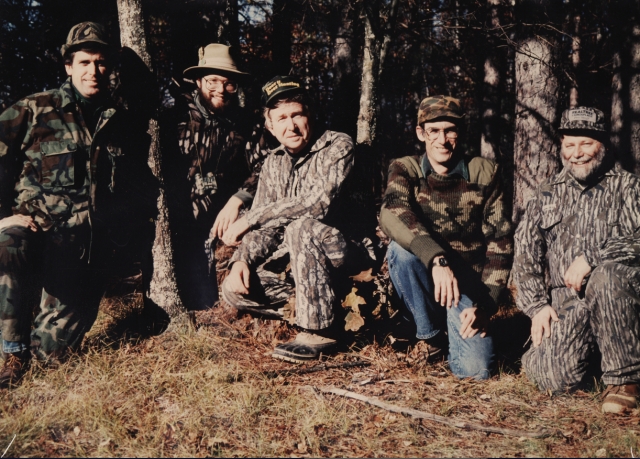
The key concept to understand with EAB is that it is different than most techniques used for increasing deer harvest. Increasing limits, lengthening the seasons and liberalizing hunting methods can all boost deer harvest. However, the increase is limited by the number of hunters and those hunters’ harvest threshold (how many deer they will kill to meet their personal needs). With hunter numbers in decline across the country, the best way to increase deer harvest is to increase the remaining hunters’ harvest threshold (plus provide them with the limits, seasons and methods to reach that threshold). That is what EAB does. It encourages hunters to adjust their harvest threshold by providing the incentive of an antlered buck. It’s like a bounty system that doesn’t cost the state or municipality money.

The problems with earn-a-buck are twofold: First, many deer hunters who are uninformed about their roles as managers and land stewards are resistant to any effort to lower deer numbers. That they have been "spoiled" by years of herds over carrying capacity and do not understand the impact of over abundant herds doesn’t help. Second, many hunters are wary of EAB because they (and statistics do bare this out to a point) are afraid it will cost them their "one chance" at an antlered buck if the buck appears before an antlerless option.

The advantages are: Foremost, EAB is the most effective way to increase antlerless harvest given a stable or declining hunting force. In addition, it has been shown that EAB  increases the ratio of mature bucks in the population, which is an advantage for those seeking larger antlers. Part of this increase might come from that sometimes real disadvantage of missing out on a chance at a mature buck. More often though, hunters in EAB regulations become more selective with their buck harvest after they have an antlerless deer in the freezer.

I think one of the key adjustments to EAB regulations is allowing hunters the ability to "pre-earn" their buck authorization a year in advance. This allows hunters to eliminate that notion that they will miss out on their chance of a "buck of a lifetime," whether perceived or real. Duluth, Minn., which has one of the most successful municipal hunts in the country thanks largely to EAB regulations (in a state that typically does not employ EAB on a large scale, I might note) recently sought to require the harvest of two antlerless deer first. The measure was struck down. However, had they allowed pre-earning, perhaps the outcome would have been different.

I’m sure managers will continue to explore this regulation in the future, fine-tuning it and modifying it for specific situations. In fact, because of its extreme nature, its cost/benefit structure and the increasingly disparate distribution of whitetails, it might be best suited for small-scale management rather than statewide regulations. However, it is important for hunters to completely understand this management tool if they are to understand their roles as managers.

Food Fun Friday Special Moments

As a somewhat new father of 15-month-old twins, I’m constantly finding myself enjoying tiny little moments with my kids that I never knew I would experience. Last night, my boy Sam, provided another great one — a moment for the ethical hunter archives.

My twins, Sam and Anna, have been eating solid foods for a long time now, and have tried a variety of wild game meats, including fish, goose, moose and whitetail. However, Sam is now a big fan of chicken meat. Sam has also been connecting pictures of animals with the sounds they make, including "baaa" with sheep, "moo" with cows and "bok bok" with chicken photos and drawings. Last night, my wife placed a piece of chicken on Sam’s tray and asked him if he wanted some. Sam held it up, then said "bok bok" and popped it into his mouth. He repeated this process several times with a pleased look on his face each time.
chickens cooking
Not only was I proud of my boy for learning what chickens say, but the fact that he was forming a rudimentary connection between his food and its origins made the ethical hunter in me beam. You can bet my kids are going to know meat doesn’t come from a factory or grocer. Venison comes from deer, pork from pigs, beef from cows, etc.

Venison eatersNow, the day when Sam and Anna watch me bring home a deer and explain that we kill animals for their meat, completing a natural circle of dependence (you know, like the Lion King) doesn’t seem that far off. Nor does the day they pull up a stool to watch me skin and butcher a fat doe. Or, their own first hunts. These are the moments ethical hunters live for.
P.S. for a great resource on butchering and cooking venison (for you or your kids) check out a fellow ethical hunter’s great book "Gut It, Cut It, Cook It" in the ShopDeerHunting.com store.

Taking On Antler Addiction

Most of history’s best decisions have not been made with a tumbler of straight bourbon whisky in hand. However, profound thinking and whisky are fine companions. What I’m getting at is this: I’ve been holding off on this post for a while. Why? Because I wanted to get it right. But in the end, that’s just wrong. Blogs are for pouring out ideas and sparking debate. So here goes.

For the past several years, I have watched as the Deer & Deer Hunting offices have experienced a large uptick in letters, calls and e-mails from hunters dismayed by what we have collectively termed as a national antler addiction. In fact, some of our most applauded and contentious articles and television shows have attempted to dive into this subject, bringing both acclaim and anger from our hunting readers.

A quick scan of a local newsstand this weekend revealed D&DH is no longer the only magazine taking up this issue. Many of the other national publications have either toed or dove directly into this discussion of an ailing deer hunting ethic. And it is a sticky discussion because, at it’s heart is a natural drive for hunters to measure their success and the very primal nature of antlers themselves.

It’s murky water. And for ethical hunters, I think it’s worthwhile and necessary to fully explore this subject. In my opinion (which is the whole point of a personal blog), there really is nothing wrong with an antler fascination and attraction. Antlers captivate us because their very purpose is to awe and convey virility and strength. The problems arise when the attraction crosses a line into addiction and hunters place large antlers above herd management, stewardship, sportsmanship and even decency. Antler addiction is bad because, like any addiction, it spirals to spawn a whole host of negative activities and emotions.

So are big antlered bucks to blame? Nope. How about the hunters who delight in the taking of these animals? Certainly some cross the line, but not all.

big whitetail antlers huge whitetail rack
I think the evils of antler addiction are a symptom of society. OUR society. To put it bluntly, our keeping-up-with-the-Joneses, instant gratification, no-fault-of-our-own, over-commercialized way of life. This is what turns quality deer management focused on healthy ecosystems into trophy deer management or worse.

If you look closely at the ugly side of big buck hunting, the nasty issues always revolve around egos, glorification or greed.  Often I think property owners look at the enormous time and monetary investment they put into their management programs and feel they must show a return on that investment. Few see less obvious returns of a healthy ecosystem and natural balance. Greed and egos are just that.

So what is an ethical hunter to do? Shun big bucks? Hardly. I think it is important to focus attention on the less obvious returns. Place an emphasis on land ethic. Simply; enjoy antlers, but do not enjoy them more than the hunt and do not place the hunt above its purpose. 

Food Fun Friday (What now?)

It’s time to face the harsh reality: My freezer is empty, or almost so.

Moose steaks from my sister? Gone.

Moose burger? Ditto.

Nebraska buck? Finished him off last week.

Wisconsin doe? Mostly gone. (I am holding on to a bag of honey hot sticks like they are Apple stock circa 1977)

I guess I didn’t do my fair share of wildlife management last season. So that leaves me with the harsh reality of shopping for my protein. (Have you seen the price of beef lately?!! It’s enough to induce depression.) Thank goodness for my garden. I can’t wait to start harvesting fresh veggies … but that won’t cure my venison doldrums.

I guess all I can do now is wait and plot. First, I must make sure to secure more venison this fall. And with the Oliso vacuum sealer I mentioned in a previous post, I’m planning on putting more up than ever before. But until then, I guess all I can do is daydream about opening day and put up veggies for fall. I’ll be reading up on recipes, too. And taking suggestions. What’s your favorite venison recipe? Or recipe book?

Best venison cookbookThis year, I tried a lot of recipes from Tracy Schmidt’s Venison Wisdom cookbook. Tracy is the wife of D&DH editor Dan Schmidt and she knows her venison. I was very impressed with the book and every recipe I tried. Tracy has a blog on her website http://venisonwisdom.ning.com/

I’ve also been reading Charcuterie by Michael Ruhlman and Brian Polcyn. It has given me a lot of ideas for the coming fall and winter. Until then, I can only wait.

By the way, which state has the earliest bow opener?

Do you know Aldo?

I often forget that not all hunters are like me. Some of the best deer hunters I know are are not outdoor writers or marketing folks in the outdoor industry who get the chance to chase deer all over the country. Most are folks who work hard for a living in factories or outdoors, building and supplying this great nation.

That’s not to say these folks aren’t great conservationists who devote themselves to protecting and managing our natural resources. However, many of these same individuals have not experienced formal conservation classes at a college level. That does not make them less valuable to our environment. But I often forget that these folks might have never read envioronmental classics such as Rachel Carson’s Silent Spring or the writings of John Muir and Thoreau. If you have never heard of these people, it doesn’t make you less of a conservationist, and I don’t look down at you one bit. However, I would say you are missing out on some great environmental ideas if you can handle a bit of heavy reading (and even some anti-hunting rhetoric).

However, for us hunters, one author and environmentalist stands above all others (at least in my mind). He was ahead of his time and wrote of ideas that can still shake natural resources management to it’s core. What’s more, his writing verges on beautiful, and he was, indeed, a hunter. Yet, until college I had never heard of Aldo Leopold (1887 – 1948). Then, throughout my college career, I was asked to read his writings several times. To say the least, I was shocked by his wisdom and eloquence. Leopold’s land ethic is what we should all strive for as hunters.

A Sand County Almanac by Aldo LeopoldToday, I carry a well-worn copy of his greatest work A Sand County Almanac in my hunting pack and try to read it once a year. It makes for great midday deer stand fodder. It should be noted that Leopold is often quoted by anti-hunters and hunting conservationists alike. This is because his ideas are profound, and complicated. They do not bend to causes. And to just read his most famous quotes is to just sample his knowledge. Leopold was a hunter who valued the environment beyond movements. In fact, he championed doe hunts in Wisconsin at a time when it earned him death threats. In my mind, he was the greatest hunting conservationist. A man to model and admire.

So, if you are looking for a some great summer reading that just might change the way you view deer hunting and the woods you love, I suggest you pick up A Sand County Almanac, whether you know him or not. And if you don’t like to read, a full-length, high-definition documentary film was recently made about the legendary man. Green Fire highlights Leopold’s extraordinary career, tracing how he shaped and influenced the modern environmental movement and how he remains relevant today, inspiring projects all over the country that connect people and land. You can find more, including a trailer, at www.greenfiremovie.com. You can also learn more about Aldo Leopold and how the Aldo Leopold Foundation continues to carry on his work at www.aldoleopold.org.

I can promise, this won’t be the last post I write that explores Leopold’s land ethic and its influence on me as a hunter.