A graph compiled by DNR wildlife biologist David Jentoft that he shared with the Natural Resources Commission at their April meeting, clearly shows why a one buck bag limit won’t work in the UP. The graph shows the direct relationship between the severity of UP winters and the number of bucks hunters in that region bag on an annual basis. After severe winters, the number of bucks taken by UP hunters goes down and it goes up after mild winters.
In other words, winter controls the number of bucks that are present on the landscape, not hunter harvest. That is why having mandatory antler point restrictions on both buck tags of UP combination deer licenses since 2008 has not produced more older age bucks during the 17 years those restrictions have been in place. That’s also why a one buck bag limit will not be successful in doing so either.
So changing the buck bag limit from two to one in the UP will not benefit the resource at all, as proponents of the change claim. What it will do is dramatically reduce recreational opportunity for UP hunters without changing the boom and bust cycle of deer abundance controlled by winter severity.
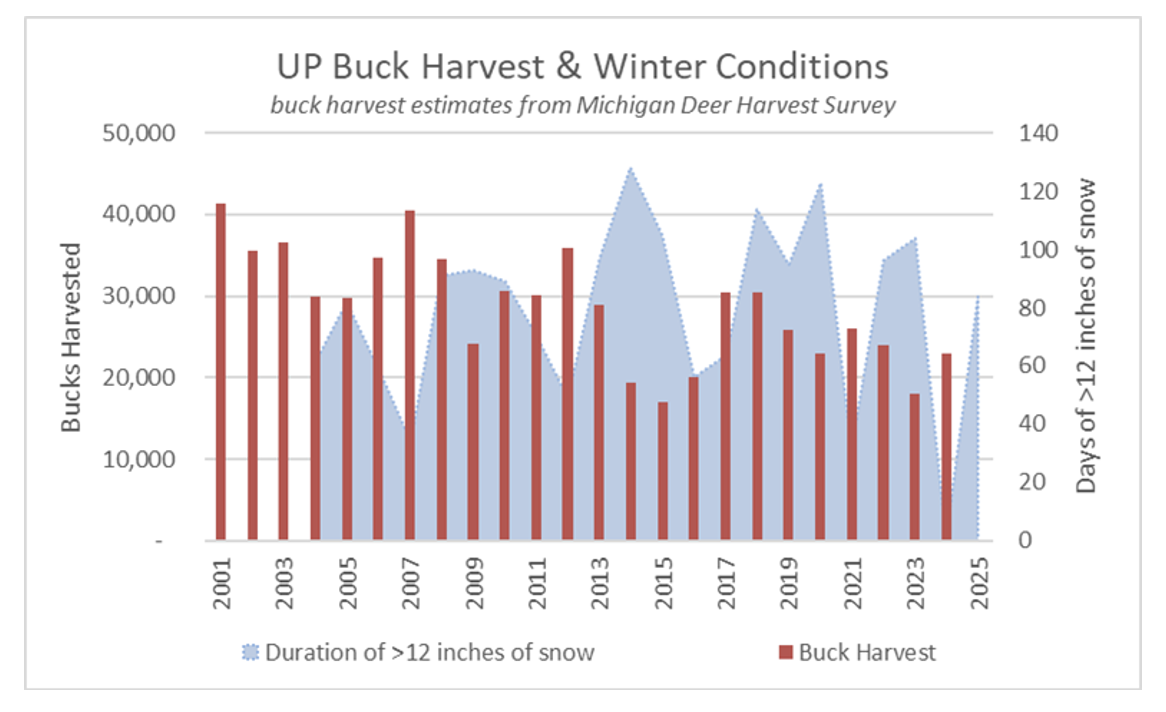
The connection between winter severity and the number of bucks available to UP hunters is undeniable from the graph produced by Jentoft. The severity of UP winters is determined by the number of days that snow depths average 12 inches or more. Winters in which those snow depths range between 60 and 90 days are considered moderate. Mild winters are less than 60 days and those with more 90 days of deep snow are considered severe.
The DNR graph shows the buck harvest from 2001 through 2024. The comparison between winter severity doesn’t start until 2004. It’s safe to assume, however, that the winter of 2003-2004 was severe because the buck kill declined to 30,000 during 2004 and 2005 from around 35,000 the previous two years. Since the number of bucks tagged by UP hunters exceeded 40,000 during 2001, it’s also safe to assume the previous winter or two were mild ones.
Mild to moderate winters prior to the fall of 2007 resulted in the UP buck kill rebounding to 40,000. The region’s buck harvest has been on a downhill trajectory since mandatory antler point restrictions on UP combination licenses went into effect during 2008 seasons. A severe winter during 2008-2009 dropped the 2009 buck harvest to about 24,000.
Moderate to mild winters for several years bought the buck kill back up to about 36,000 in 2012. Then two or three severe winters in a row brought the number of bucks bagged by UP hunters to record lows to record lows between 2014 and 2016. So many deer were lost during those winters that it took four years for the herd to rebound.
Mild winters, of course, contributed to the increase in the number of antlered whitetails available to hunters by 2017 and 2018. More tough winters brought the population back down again. Only about 18,000 bucks were bagged in the UP during 2023 seasons, according to DNR estimates, which is less than half the number of bucks shot by UP hunters during 2007 seasons. Making both buck tags restricted starting in 2008 obviously has not been beneficial in producing more older age bucks for UP hunters, according to this revealing graph. A one buck bag limit won’t do any better.
The winter that just ended was severe again, so the odds of UP hunters filling two buck tags this fall will be reduced. The one buck bag limit that is essentially already in effect will continue without any change in regulations.
Read more related articles: