Over the course of the ice season, soft-bottom flats are places where an angler can often find and catch panfish. Despite having fairly monotonous terrain, there’s actually a lot going on at the kinds of soft bottom areas that many panfish call home during winter. Let’s dig into the details of what makes mucky floors such fantastic spots for panfish, along with reliable ice-fishing techniques for catching yellow perch, crappie and sunfish from these nondescript, yet productive locations.
Soft Spots Serve Up Food
Several factors draw panfish to the squishy sections of a lakebed. Mud, sand and other mushy substances carpeting the floor provide habitat for zooplankton, bloodworms and various nymphs. Add some vegetation or sunken wood cover into the mix, and the area — if it didn’t already — likely will have crayfish, freshwater shrimp, snails and other buggy morsels. This smorgasbord attracts baitfish and, naturally, perch, crappie and sunfish.
Open Space = Security
Along with holding ample forage, the expansiveness of soft-bottom flats helps panfish avoid becoming a meal themselves. The open water helps schools of perch, crappie, bluegills and pumpkinseeds keep a safe distance and evade attacks from predators like muskies, northerns, walleyes and lake trout.
I’ve seen this with my own eyes several times with Garmin’s LiveScope’s Down View. After catching crappies, pumpkinseeds and bluegills, the herd suddenly begins swimming to the side, then vanishes. Moments later, the unmistakable profile of a large Esox swims into view. When this happens, one option is relocating a short way to find another pod of biting panfish.
Another solution to the predator problem is catching them, provided the fishing season is open. This is ice-fishing outfitter Jim Carrol’s strategy when a big pike arrives on the 4- to 12-foot sand flats he fishes for jumbo perch on Lake Erie. Carrol always has a silver Williams Whitefish (C90) rigged on a rod to catch northerns.
“Perch scatter and the fishing isn’t as good when pike are around,” Carrol said. “You have to catch them or sting them for pike to leave where you’re fishing.”
Reliable River Locations
I grew up fishing river back bays, sloughs, canals and inlets for panfish, and still regularly visit those areas. From first ice to the last weeks of the season, panfish often live in soft-bottom, backwater areas.
Panfish have a habit of congregating around isolated features. Anything different is good; the bigger the feature the more likely it is to hold more fish.
A section in a back bay where the bottom drops a couple feet can stack up panfish. Standing trees, stumps and sunken brush are other attractors.
Another good find is chara. Crayfish love this aquatic tumbleweed. Finding good patches of chara likely means you’re not far from good yellow perch fishing, not to mention crappies and sunfish.
Soft-Bottom Lake Scenarios
At first ice, panfish relate to the last remaining healthy weed beds in lakes.
Fishing clumps of isolated cabbage growing on 12- to 14-foot soft-bottom flats positioned just beyond either a bay or a large, slightly shallower weedbed has rewarded me with some excellent crappie and bluegill fishing many times.
Fish may be oriented tight to weed clumps. In other instances, they roam suspended adjacent to the greenery. These areas can be fun places to fish during the day, particularly if it’s overcast. More impressive, though, is how these zones get flooded at dusk by crappies and sunfish hunting zooplankton and any other tiny edibles.
Moving beyond the the last bastions of vegetation, look for panfish on soft-bottom flats in 16- to 30-foot depths. These are common midwinter hangouts. But, anglers can also find panfish in these areas early and late in the season in some instances.
As with river backwaters, success on lakes can hinge on finding isolated features. Similar isolated pieces of cover or structural variances, as noted above, can be just as appealing to panfish in lakes.
Slight depressions of a foot or so can be fantastic finds on lakes, for instance. I once listened to Brian Brosdahl wax poetic on the importance of dimples and slight depth changes on soft-bottom areas. His theory is that these areas collect leaves, dead aquatic plants and other organic matter, which attract invertebrates and, subsequently, hungry panfish.
Positioning yourself on a flat outside of a marsh, fertile bay or shallow weed flat is another smart play. These shallow areas contain a lot of organic matter, which gets moved around by wind and waves, but eventually settles on flats. I’ve interviewed several ice-fishing pros, Brosdahl just one of them, over the years who’ve talked about fishing flats adjacent to steep drop-offs beyond fertile shallower areas. The theory being that the slope’s sharp angle encourages sediment to slide down and collect where the flat meets the drop-off. Over time, a rich aquatic compost develops there and becomes a home for all kinds of panfish food.
Another productive strategy is targeting flats close to offshore structures, such as humps and sand bars. The panfish might be holding well beyond these features, but the area’s overall structural complexity seems to play a role in attracting good numbers of panfish.
Subtle uprisings and bottom transitions occurring along a flat can also stall panfish wanderings on flats and cause them to loiter. These include things like rock spines, isolated boulders and pea gravel deposits. For more details on these features, see my article, “Walleye Fishing 101.”
Panfish Position Within the Column
When bloodworms, crayfish and other benthic invertebrates are the predominant forage, expect to find perch and other panfish positioned tight to the floor. Invasive gobies are another bottom dweller that perch and crappies prey on.
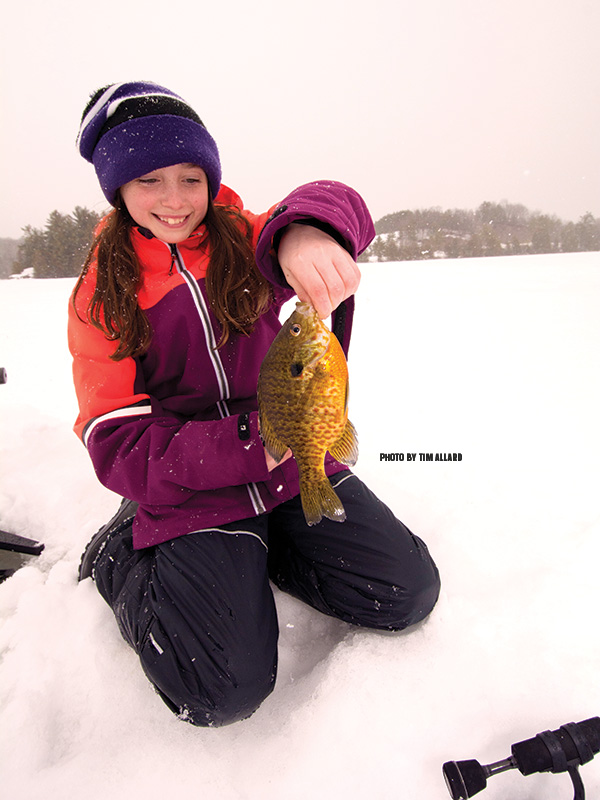
It’s also important to appreciate that panfish often suspend in these areas. I’ve caught dozens of perch midway down, gorging themselves on freshwater shrimp, for example. Crappies and bluegills feeding on zooplankton are commonly caught throughout the water column.
Food isn’t the only factor influencing where panfish are in the water column. Temperature and oxygen levels are also significant. As an example of the latter, I have caught crappies from small ponds in late winter within five feet of the ice above 20-foot deep mudflats. As winter progresses on these small-water systems, oxygen levels decrease from the bottom up, prompting fish higher, until spring runoff begins infusing oxygen back into the system.
Soft-Serve Baits and Tactics
Most anglers that I know carry several panfish rod combos rigged with various baits when embarking on panfish adventures. At one end of the spectrum are attraction baits. Things like flashy flutter spoons, rattling spoons, lipless crankbaits and jigging minnows, like a Rapala Jigging Shad Rap. Measuring anywhere from 1½ to 3 inches, these lures are excellent for attracting panfish from far away and, a lot of times, can trigger strikes from aggressive fish.
These lures do a good job of mimicking minnows and juvenile panfish. Perch can be cannibalistic.
Important, too, is assertive jigging tactics with larger lures that can appeal to large fish within a school, helping catch the bigger ones and bypass smaller specimens. Even if they don’t bite, an oversize bait supports attracting fish.
Having downsized versions of the above baits is also wise. These baits bridge the gap between panfish power-fishing baits and finesse presentations. Many times these middle-ground offerings work just fine and produce plenty of bites.
In some cases, it’s less about lure size, and more about what weight is best. Too heavy in shallow water reduces a lure’s get-noticed capability. Carrol, for instance, likes Northland Buck-Shot Rattle Spoons and Little Cleos between 1/8 and 1/4 ounce when jigging for perch in Lake Erie’s clear, shallow waters.
Small tube jigs, finesse swimbaits and crayfish plastics around 1 inch in length fished on jigs are also worth carrying. Soft baits produce different moves than hard-body lures, which panfish may prefer at times. Appendage-rich plastics also work well at mimicking invertebrates. The Berkley PowerBait Nymph is just one example.
Going on the ice without finesse baits for panfish is asking for trouble. When the water column is filled with zooplankton and other teeny-tiny critters, fishing small and subtle can be critical to getting bites.
Finesse worms on tungsten ice jigs are favorites for fussy panfish. Their thin profile and quivering action is often irresistible to even the moodiest of panfish. Nymph, shrimp and other invertebrate-lookalike profiles are also effective.
Ice jigs tipped with a couple of maggots are another go-to. Live bait is tough to beat when up against lock-jawed panfish. A fresh minnow head on a jig can be lights-out for teasing strikes from uninterested perch.
Jigging Essentials
Typical jigging cadences for the above-mentioned baits will catch panfish relating to soft-bottom areas in rivers and lakes. Aggressive lifts moving a bait through a lot of water are reliable attraction moves. Short snaps followed by a free fall or controlled drop, then a pause, and perhaps a shake, work wonders for triggering strikes with spoons, lipless crankbaits and jigs tipped with plastics or live bait.
A proven approach for fussy fish is going slow and subtle. No argument there. Yet, doing the opposite also works at times. Snap-jigging, upsizing and using an action-rich bait has the power to push panfish out of a stupor and get them chewing. This has proven true when I’ve camped out on a spot where panfish were coming through in waves.
More Tactical Considerations
In a soft-bottom context, there are two other strategies worth trying. The first is mucking the bottom with a lure. This can include pounding a spoon, Jigging Rap or other lure several times into the floor, before raising it up one to three feet and out of the stirred-up silt clouds below. On a good day panfish strike the spoon without hesitation.
Another variation that Brosdahl deploys after stirring up sediment is reeling in his Northland Buck-Shot Rattle spoon and then dropping down a finesse plastic. Panfish uninterested in smacking a spoon have a hard time passing up a snack-size finesse jig, like the Impulse Rigged Bloodworm.
Other bottom-contact tricks include tight-lining a tube on bottom, then moving the rod back and forth the width of the ice hole. This drags the tube along the floor, mimicking a crawling crayfish or other benthic bug. A similar tactic, but using ultra-slow maneuvers, is also effective when yellow perch are down-feeding on bloodworms.
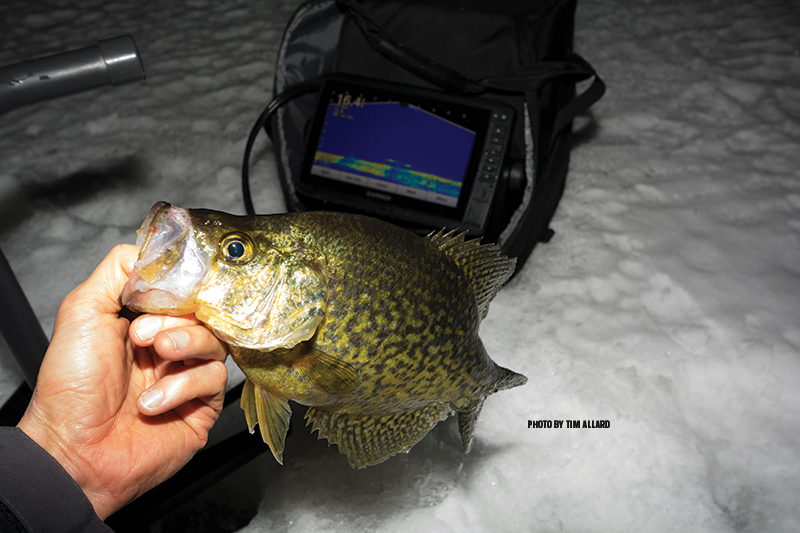
Another important soft-bottom strategy is positioning a lure well above fish, which is made easy referencing the display of a portable ice-fishing sonar. Crappies, by nature, are up-feeders. Keeping a bait overhead is key to staying within the strike zone, and a good practice.
Even better is dancing a bait several feet above a school of panfish, which can stimulate competition. When things go right, several fish dart upward, vying to be the first to eat your offering. Doing this lets you catch aggressive fish first, before jigging farther down to coax the less active ones.
The fact that zooplankton and other types of forage often suspend is another reason to thoroughly fish the water column. Many times during late ice, I’ve seen water boatmen, freshwater shrimp and other aquatic bugs swim up to the top of the ice hole I was jigging in.
Seeing these critters is a reminder to jig right under the ice every so often. For this, I prefer jigging a spoon with a metallic finish from the bottom of the ice hole down at least 18 inches. Light reflecting off the flashy spoon and ice goes all over the place, attracting curious panfish in short order. If they don’t eat the spoon, switching to a smaller offering is likely to get your rod bent.
For much of the ice fishing season, perch, crappies, bluegills and other panfish species dwell on soft-bottom flats. Keep the above location tips in mind when refining your position on these squishy regions, and try experimenting with a range of jigging presentations until you crack the code to get bites. Apply these simple concepts and you’re sure to catch a ton of panfish this hard-water season.
Guide Contacts
Jimmy Riggin’ Fishing Charters/R&R Outdoors
519-586-7990
Brian Brosdahl’s Guide Service
218-340-6051
Read more related articles: