Aquatic vegetation can hold panfish all winter. The duration, however, can vary from one winter to the next. Last winter, we saw an extremely mild winter and had much less ice and snow cover than average. The result last winter was good weeds throughout the winter that seemed to hold fish in the shallow and mid-depth ranges. Back up two winters ago and we had a much tougher winter with a lot more ice and a lot of snow on the ice. I can remember weed patterns breaking down by the beginning of the year that particular winter, and it seemed like most of the fish pushed out over the basin. When breaking down the details of weed panfish patterns through the ice, we need to take a 10,000-foot view while also attempting to understand the nuances and details.
It’s very important to note that every flowage, lake, reservoir and river has a unique personality. Some lakes, for example, have a healthy population of predators like largemouth bass or northern pike that will push panfish into deeper weeds. Some flowages have stained water where weed growth might stop in 7 feet of water. Another lake might have good weeds out to 25 feet of water. Water clarity has a big impact on what weeds are present and how deep weeds will grow. Ice thickness and snow cover can also have an impact on how aquatic vegetation can hold up through the winter. Some reservoirs that fluctuate drastically with water levels might not ever have good weed growth. Other bodies of water might be really turbid and wind-swept during the summer with floating weeds that ultimately freeze up into the bottom of the ice.
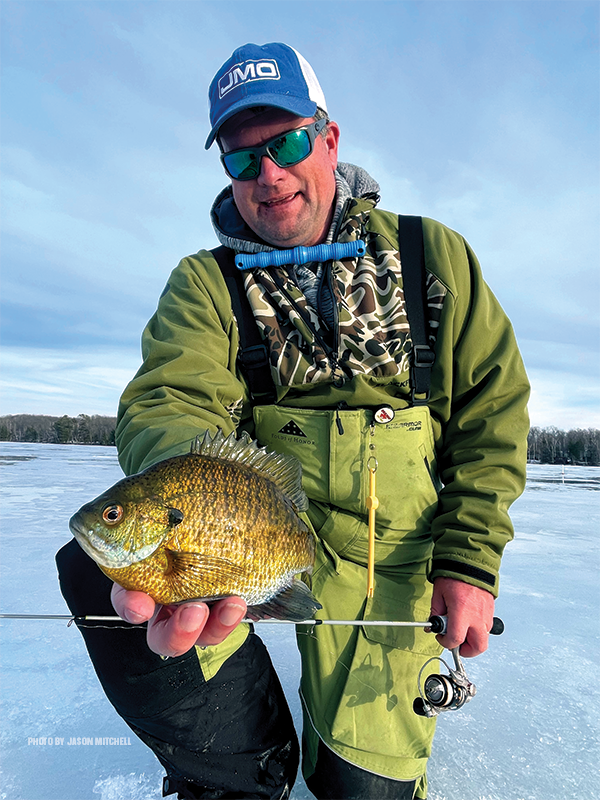
Ice anglers often talk about the importance of green weeds. Weeds that stay green during the winter often attract and hold fish, especially panfish like bluegills and crappies. We find, however, that dying brown weeds can also hold fish if oxygen levels remain high enough. Green weeds produce oxygen, while decaying or dying weeds deplete oxygen. Incoming or moving water, though, can mask the depletion of oxygen from decaying weeds. In other words, brown and down weeds can still provide cover and attract panfish if the oxygen is adequate.
To really dive into weed panfish patterns through the ice, anglers can gain some serious advantage by being able to recognize some of the more important weed types. Weed species can vary by region, but some of the more common weeds found throughout the upper Midwest include elodia, northern milfoil, eelgrass, Eurasian milfoil, curly leaf pondweed, broadleaf pondweed, bushy naiad, coontail, narrow leaf pondweed and sago pondweed. Chara also fits into the schematics, but technically Chara is an advanced algae that grows near the bottom and doesn’t have a root.
Some ice anglers believe that one specific weed is the holy grail of them all. If I could pick a couple of favorite weed varieties, I would say coontail and the broad leaf and clasping leaf pondweeds would be my top picks — but there is a caveat. We often find that panfish will relate to whatever weeds are available. The best weed locations are often a mix — a mix of edges and open lanes, a mix of weed heights and weed varieties. If you can find at least three different weed varieties in proximity, that is often the sweet spot. Coincidently, this often occurs when different types of bottom compositions meet in a small area. Could be a sand flat that has broad leaf pond weed on top. Down the break, the bottom changes and narrow leaf pond weed emerges and mixes with coontail.
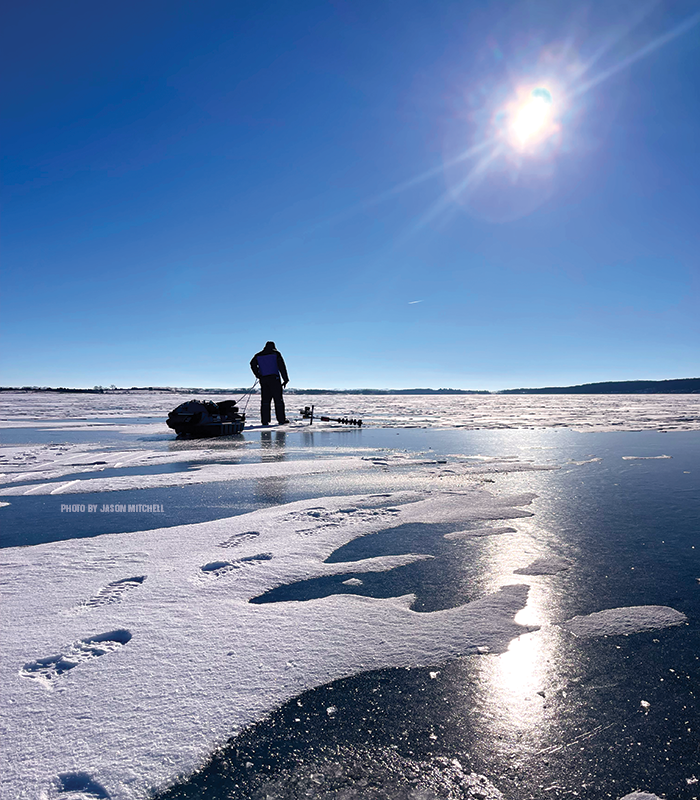
My favorite weed locations are what I would describe as clumpy. Clumps or stands of tall weeds mixed with flats of shorter weeds. Weeds that are frozen into the ice and hanging down into the water column can also make some spots better. Elodia, and the milfoils in particular, can often be hanging down into the top of the water column with part of the weed frozen into the ice.
Panfish love to have open lanes they can roam through. This is why invasive weeds like Eurasian milfoil and curly leaf pondweed can be counterproductive, in that these particular weeds can become so thick and expansive that the openings and edges disappear. In regard to the edges and multiple weed varieties making a good spot great — what really can make a weed location extremely good is a little mix of rocks or a depth change that creates a trough or bowl inside the weeds.
Of course when it comes to really doing a deep dive into weed locations, an underwater camera can become an invaluable tool for understanding the locations and types of weeds present. Underwater cameras can also be useful for finding fish in weeds. If you can’t physically see bluegills or crappies, look for the clouds of stained or dirty water. Whenever you find that dirty water, the panfish are close by.
The time of day can have a big influence on how to fish weeds. The other factor is the predator/prey relationship in a particular body of water. Time of day often influences fish movement and attitude. As a general rule of thumb, low light sees panfish like bluegills and crappies up cruising the adjacent open water around weeds. Could be the top of the water column above stands of weeds, might be the outside edge of the weed line. Could be just swimming around in a bowl where a slightly deeper change in depth created an open pocket inside the weeds. When fish are moving during the prime windows, you can sit on key spots and run traffic.
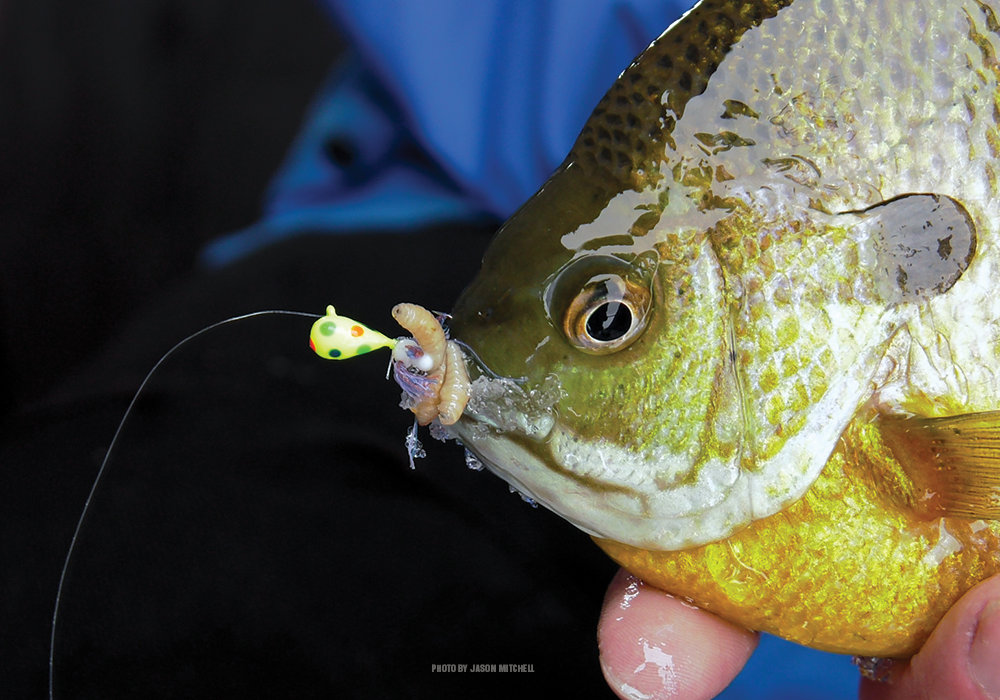
The middle of the day, however, can push fish into the weeds where they bury into the cover and are not cruising. High, bright sun will often push panfish into heavy cover. The other factor is predators. They create a situation where you need to fish much more aggressively. We often rip grids of holes and fish with heavier presentations. Drilling more holes accomplishes two things. First, you get in contact with more fish when the fish are no longer moving enough to come into contact with you sitting in one location. You can go to the fish when that bubble gets smaller. In this situation, though, you still need to pull fish to you.
If fish are buried halfway down into some coontail, for example, you still might need to raise the fish 3 or 4 feet in order to catch them. This is why the bigger presentations can be so important for catching panfish during the tougher time periods like midday. You need to use something that will pull fish up out of the weeds, or you need to use something heavy enough to drop through some of the canopy if you have to fish down into the weeds. My favorite overall jig for punching into weeds or pulling fish up out of weeds is simply a CPT Tungsten Drop XL on 4-pound Frost fluorocarbon. I find that the heavier fluorocarbon works especially well in dense weeds. Tall weeds that have tough stalks, like narrow leaf pondweed, are just too much for 1-, 2- or 3-pound monofilament when fish are big enough to wrap around stalks.
The second factor that drilling grids of holes at midday accomplishes when fish are no longer active and cruising, is that the drilling will often move fish around just enough to make them easier to catch. I often stagger the grid, in that I might pop a dozen holes in an area and then keep creeping along with an additional half-dozen to a dozen holes at a time, to move fish back through my old holes.
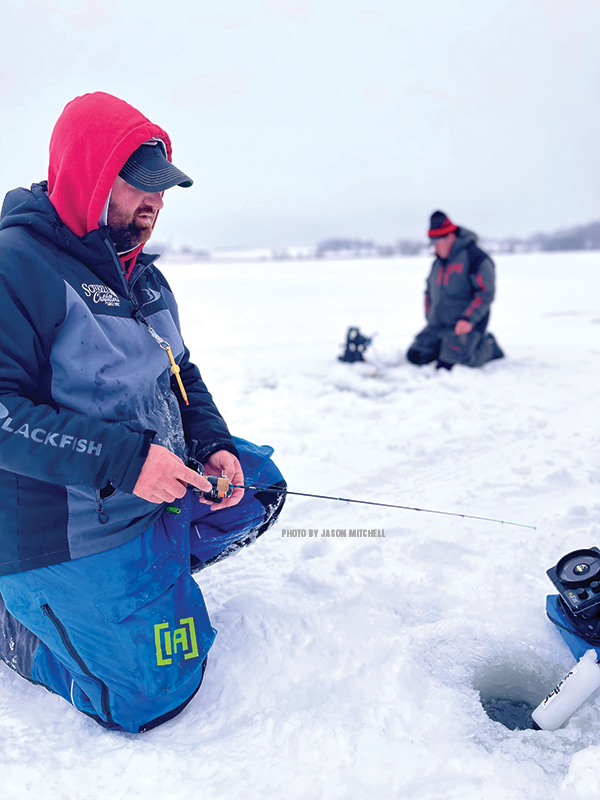
Of course, there are some situations when anglers can physically sight fish for panfish in weeds. If you have the opportunity to sight fish, I encourage you to do so just for the education alone. Ice anglers that spend time sight fishing have a distinct advantage in triggering and catching fish, in my opinion, because you simply learn so much on how fish approach the presentation and what the presentation needs to look like in the water to catch fish. Sight fishing also generally occurs in water with excellent visibility, which by default usually makes panfish harder to catch and also encourages weed growth.
But, sight fishing isn’t always possible, and when you can’t sight fish, your electronics become incredibly valuable. For customizing settings with low-power mode features that are invaluable in weeds, nothing beats a Vexilar for catching fish. Forward-facing sonar, however, can also be a valuable tool for finding weeds or finding fish. As a rule of thumb, I scan with the Lowrance Active Target to not only look for fish, but also look over the terrain. Forward-facing sonar like Active Target enables me to see not just fish, but also where the tallest weeds are located. I can see the open pockets and lanes. For seeing fish in weeds, turn your contrast down enough to almost tune out the weeds. The fish will be a brighter return.

Even on an ice bundle, forward-facing sonar units are cumbersome to move from hole to hole. Drilling a second hole for the transducer pole simply slows down the process of putting your jig in front of as many fish as possible. Fishing with the transducer pole in the same hole you are fishing is something you will regret when you stick a 15-inch crappie. I use the Vexilar for physically trying to catch fish and moving from hole to hole. Again, use low-power mode and tune your gain down to cut out the clutter on the dial created by weeds. Look for fish moving up or down in the water column. Often, you will see fish in dense weeds when they move. Tune your power down so that you get gaps in the weeds and look for fish to move through the gap.
If you love to target panfish through the ice, weeds are a vital part of the playbook. There are some fisheries where weeds are the entire playbook and other fisheries that see weed patterns fire up at early and late ice. If green weeds are present, you can almost bet that panfish are present in some capacity. Not all weeds are equal, though. If a body of water doesn’t have many weeds or is a predominately deep body of water, any shallow bay that has good weed growth might realistically hold 90% of the panfish in that entire waterbody. Other fisheries have no shortage of weeds, and the best locations are more nuanced. On water where there is no shortage of weeds, look for the flats or pieces of structure that have multiple weed varieties in close proximity.
Read more related articles: