Bans on baiting are often implemented to reduce the spread of diseases such as chronic wasting disease (CWD) and tuberculosis (TB), but these bans are not effective. In fact, they can contribute to the spread of diseases by reducing hunter success, which means fewer sick deer are being killed. The best way to limit the spread of disease among deer is to reduce deer numbers, especially adult bucks that have the highest infection rates, by harvesting more of them.
Proof from TB Management Zone
The first evidence of this can be seen in the TB Management Zone in Michigan’s northeastern Lower Peninsula. Baiting was banned in Deer Management Unit (DMU) 452 in 2002 to try to reduce the spread of TB. It didn’t work. The prevalence of TB in deer harvested by hunters in that zone in 2003 and 2004 was 1.7%. In 2022 and 2023, TB prevalence in the same zone was still 1.7%.
The data from 2023 may not be as accurate because fewer deer were tested for TB that year due to reduced availability and hours at check stations. In 2022, 66% of the deer checked at stations were tested for TB, while in 2023, only 58% were tested.
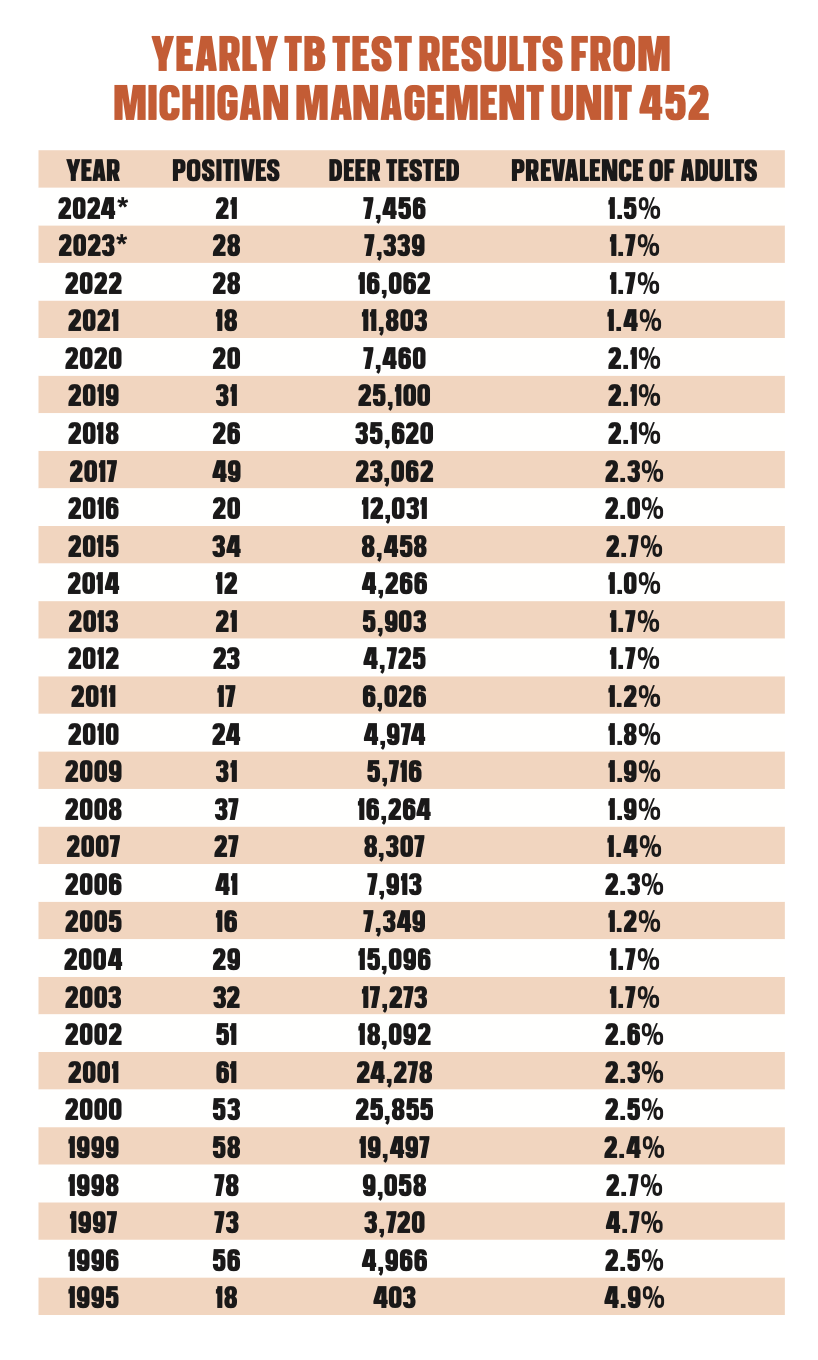
The year before the baiting ban went into effect in DMU 452 (2001), the TB rate was 2.6%. It was 2.6% again in 2002, the first year baiting was banned. Rates in more recent years were 2.1% from 2018 to 2020, 2.7% in 2015, and 1.0% in 2014.
Bucks Have Higher Rates
Adult bucks have always had higher rates of infection than does. MDNR officials are no longer providing prevalence data by sex and age class, claiming there are not enough personnel to make those determinations. But here’s what the data used to show:
In 2002, the overall prevalence of TB in DMU 452 was 2.8%, but it was 7.17% in adult bucks and only 1.2% in adult does. In 2003 and 2004, the overall prevalence in the zone was 1.7%, but adult bucks had infection rates of 4.2% and 3.6%, compared to only 1.2% and 1.5% for adult does.
These numbers clearly show that adult bucks are the primary carriers and spreaders of TB, yet DNR regulations have protected these deer with antler point restrictions (APRs), including in the CWD core area of Montcalm County.
Baiting Not Proven to Spread TB
There has never been proof that TB is spread through baiting. An effort to prove this was made in Presque Isle County, where a deer enclosure contained 12% infected deer. Even in that confined setting, researchers could not find TB bacteria in any food, water, or soil samples. The bacteria do not live long in the open, since sunlight kills them.
Researchers did infect deer through food in a laboratory, but they used conditions that don’t reflect what happens in the wild. If baiting were spreading the disease, TB prevalence should have increased since the ban. But it has remained relatively constant or declined.
CWD Spread Despite Baiting Ban
In 2019, baiting was banned throughout the entire Lower Peninsula to try to slow the spread of CWD. At the same time, the DNR approved a 3-year experiment in a portion of the CWD core area in Montcalm County to test mandatory APRs on yearling bucks. Bucks that would have otherwise been legal to shoot were protected.
During the two years prior to this experiment (2017 and 2018), 22 yearling bucks tested positive for CWD in Montcalm County alone. Those yearling bucks accounted for 37% of the CWD positives but only 27% of the deer tested.
Mandatory testing of all deer in that area was required in 2017 and 2018 but has not been required since. The only way to find out if the MAPR experiment worked would have been to continue testing deer in that area. But the DNR didn’t want to know if it failed. They stopped mandatory testing and reduced the availability of testing. As a result, we have no idea how many infected deer are being harvested in that zone today.
We do know that CWD has been confirmed in two new counties that did not previously have positive cases – Mecosta and Washtenaw. Those counties are adjacent to others where the disease was found earlier.
Protecting Disease Rather than Preventing It
Even though it’s well known that yearling bucks are the primary carriers and spreaders of CWD, one tag on Michigan’s combo deer license still protects most yearling bucks in the CWD zone. A buck must have at least four points on one antler to be legal with that tag.
The DNR has made it increasingly difficult to test deer for CWD in recent years. In 2024, only 4 of the 15 counties where CWD was detected had drop boxes where deer heads could be submitted for testing. Those counties were Ingham, Eaton, Clinton, and Gratiot.
The county with the highest number of CWD cases – Montcalm – did not have a drop box. Neither did Kent or Jackson Counties. The only way to get a deer tested in counties without drop boxes is to remove lymph nodes from the deer yourself and pay for the testing. Some hunters who have gone this route failed to receive results, likely because the wrong tissue was submitted.
Firsthand Accounts
William Drews from Montcalm County has harvested three deer in a row that tested positive for CWD. He continues to test every deer he harvests and pays for the testing, but he is becoming increasingly frustrated.
“I pay taxes, buy hunting licenses, and now I have to pay to get deer tested to make sure they’re safe to eat,” Drews said. “I don’t want to eat a deer with CWD, but I don’t know how much longer I’ll keep hunting.”
Drews’ daughter, who is a medical professional, already gave up deer hunting due to concerns about CWD.
Joe Wilson from Eaton County had a buck he shot in 2024 test positive for CWD. It was the first positive deer from Walton Township, where he hunts. He continues to have his deer tested and pays out of pocket to make sure the meat is safe to eat.
Wisconsin: A Cautionary Tale
Wisconsin has been dealing with CWD longer than Michigan and offers free testing throughout the state, so we have better data on what’s happening there. Despite a baiting ban that’s been in place in many parts of Wisconsin for years, CWD has now been found in 64 of the state’s 72 counties.
In Sauk County, for example, the infection rate for does is between 33% and 37%, and for bucks, it’s between 45% and 48%. Each year, new counties report their first positive cases. The disease continues to spread despite the baiting ban.
Out West: High Prevalence Without Baiting
Some of the states with the highest CWD prevalence have never allowed baiting, such as Colorado and Wyoming. Forty-two of Colorado’s 51 deer herds have tested positive for the disease. CWD is widespread in both mule deer and whitetails in Wyoming.
Social Behavior Is the True Culprit
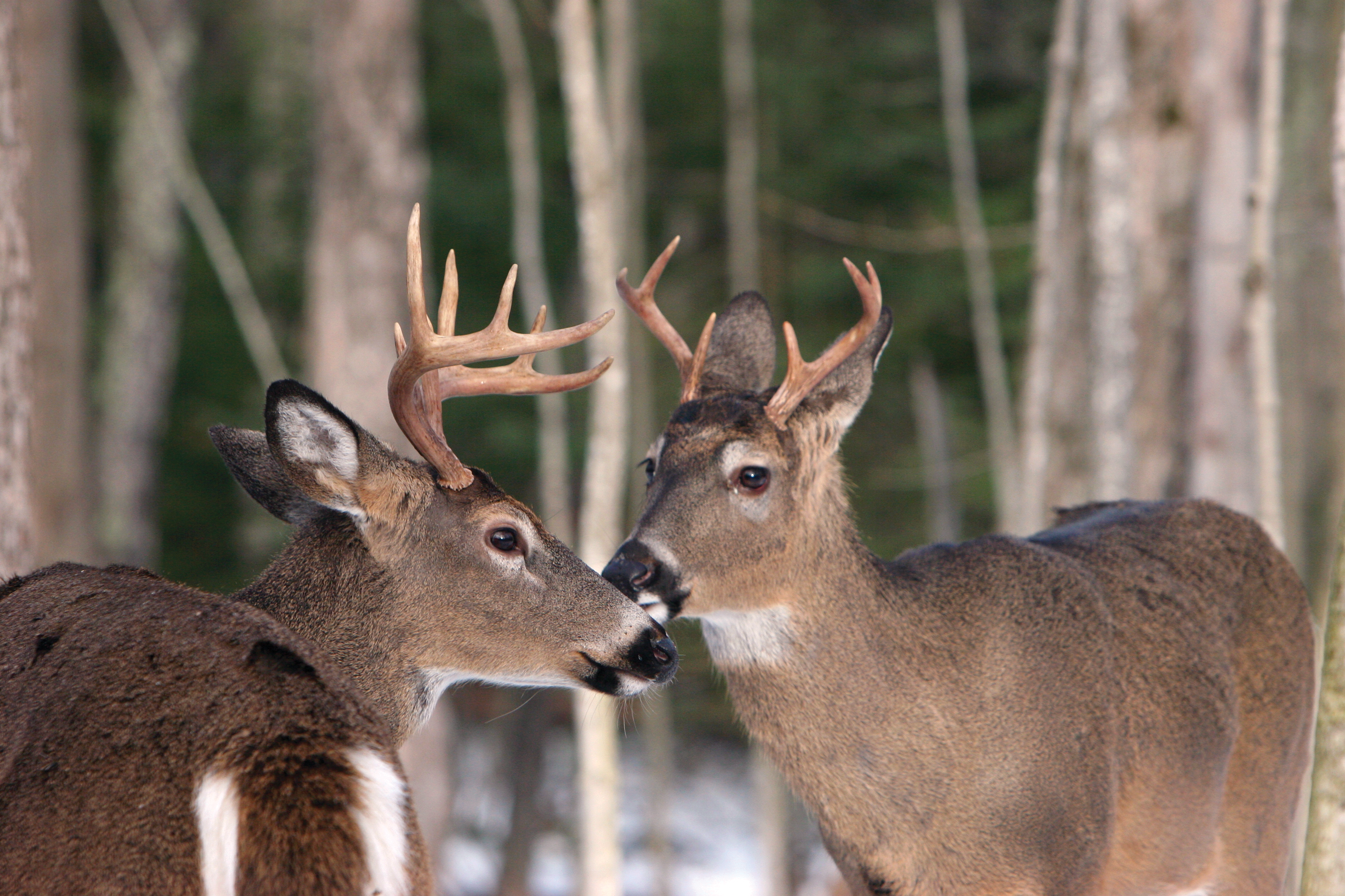
Whitetail deer often engage in social behaviors that involve close contact with other deer. This includes grooming, sparring, and sniffing each other. Does and their fawns often stay together for life and continue grooming one another as adults. Much of this contact is unavoidable and happens even more frequently outside of bait sites.
Most of the deer seen at bait sites are does and fawns, which are usually related and already in close contact throughout the day. Unrelated deer that visit bait sites are often chased off by dominant does. This natural social behavior contributes far more to disease spread than baiting ever could.
Harvest Decline Hurts Management
Data from DMU 452 from the year before baiting was banned (2001) showed the significant impact baiting has on hunter success. Archers who used bait had a 41% success rate, compared to only 13% for those who did not. Firearms hunters over bait had a 51% success rate compared to 39% for hunters without bait.
After baiting was banned, many hunters left the zone, and fewer deer were harvested. That means fewer infected deer were removed from the population, allowing the disease to spread further.
CWD Continues to Spread in Michigan
Despite baiting bans, CWD continues to spread in Michigan. The DNR has eliminated testing drop boxes in many counties, made testing more difficult, and imposed APRs that protect infected bucks. The problem is getting worse – not better.
If we want to stop the spread of CWD, we need to remove APRs in affected areas, allow baiting to increase hunter success, and offer easy and free testing for deer.